
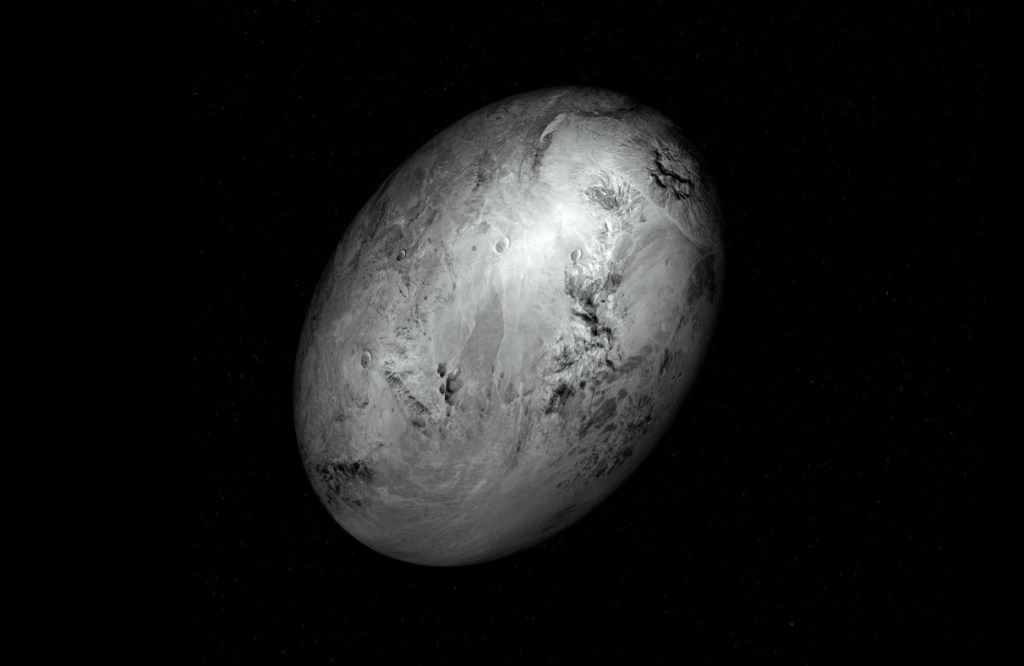
- Astronomers have utilized a decade of ultra-precise Hubble Space Telescope observations to advance our understanding of the Haumea system, detecting its nonspherical gravitational potential and shedding light on the dynamic interactions between Haumea and its two moons, Hi’iaka and Namaka.
- The research suggests that Haumea’s unique features, including its rapid rotation and collisional family, could stem from a massive collision event, with further implications for the formation of its moons and ring system through ejected water-ice chunks.
- This study not only provides new insights into the complex dynamics of the Haumea system but also contributes to the broader understanding of satellite formation and evolution in the trans-Neptunian region, setting the stage for future high-quality observations.
In a recent study, astronomers have advanced our understanding of the complex dynamics of the Haumea system, a dwarf planet located in the Kuiper Belt, beyond Neptune. Haumea is known for its rapid rotation, unique shape, and the presence of two moons, Hi’iaka and Namaka, along with a ring system and a family of spectrally distinct objects nearby. Recent studies have focused on the detailed modeling of the gravitational interactions between Haumea, its moons, and the implications these have on our understanding of the dwarf planet’s interior and the broader processes of satellite formation in the outer solar system.
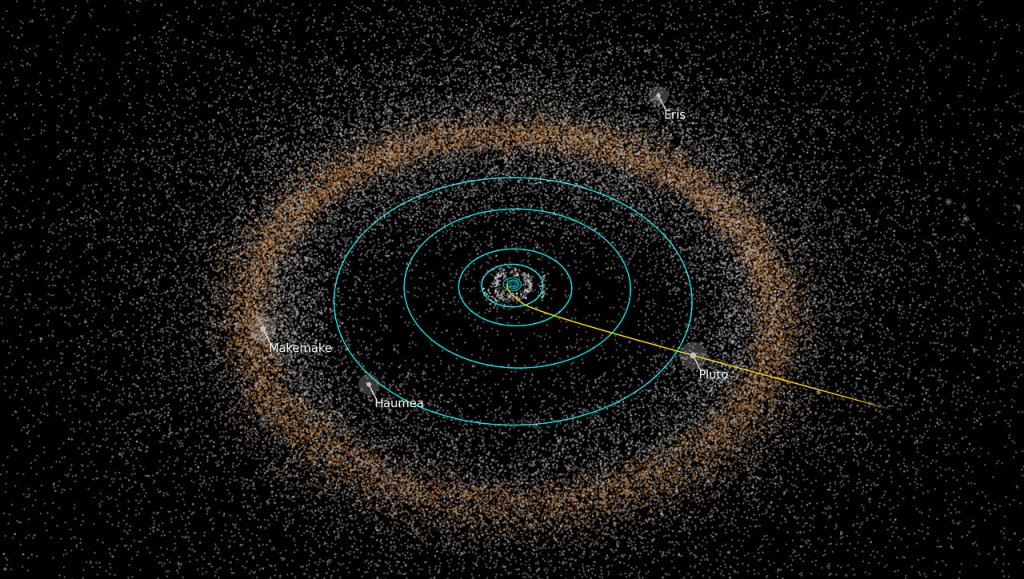
Utilizing a decade of ultra-precise observations from the Hubble Space Telescope and advanced computational techniques, researchers have now detected Haumea’s nonspherical gravitational potential, offering new insights into the dwarf planet’s shape and internal density distribution. This research underscores the potential differentiation of Haumea’s interior, which could provide valuable clues about its formation and the characteristics of ocean worlds.
The study delves into the origins and dynamics of Haumea’s satellites, suggesting they may have formed from a collisional event that also created Haumea’s fast rotation and its unique collisional family. This event could have led to the ejection of water-ice chunks, contributing to the formation of the moons and possibly Haumea’s ring. The analysis reveals that the satellite orbits are strongly influenced by their interactions with each other and Haumea’s oblate shape, shedding light on the complex spin-orbit dynamics within the system.
One of the key findings from the research is the potential for axial precession of Hi’iaka, which could have significant implications for our understanding of satellite dynamics over time. The study also presents an ephemeris for the Haumea system for the next decade, aiming to facilitate high-quality observations and further research into this intriguing celestial family.

These discoveries not only enhance our knowledge of the Haumea system but also contribute to the broader understanding of satellite formation and evolution in the trans-Neptunian region. The ongoing investigation into Haumea and its companions offers a promising avenue for uncovering the mysteries of the outer solar system and the processes that shaped the early primordial disk from which these objects originated.
Source: Benjamin, et al. “Beyond Point Masses. III. Detecting Haumea’s Nonspherical Gravitational Field.” The Planetary Science Journal, vol. 5, no. 3, 2024, p. 69, dx.doi.org/10.3847/PSJ/ad26e9, https://doi.org/10.3847/PSJ/ad26e9.
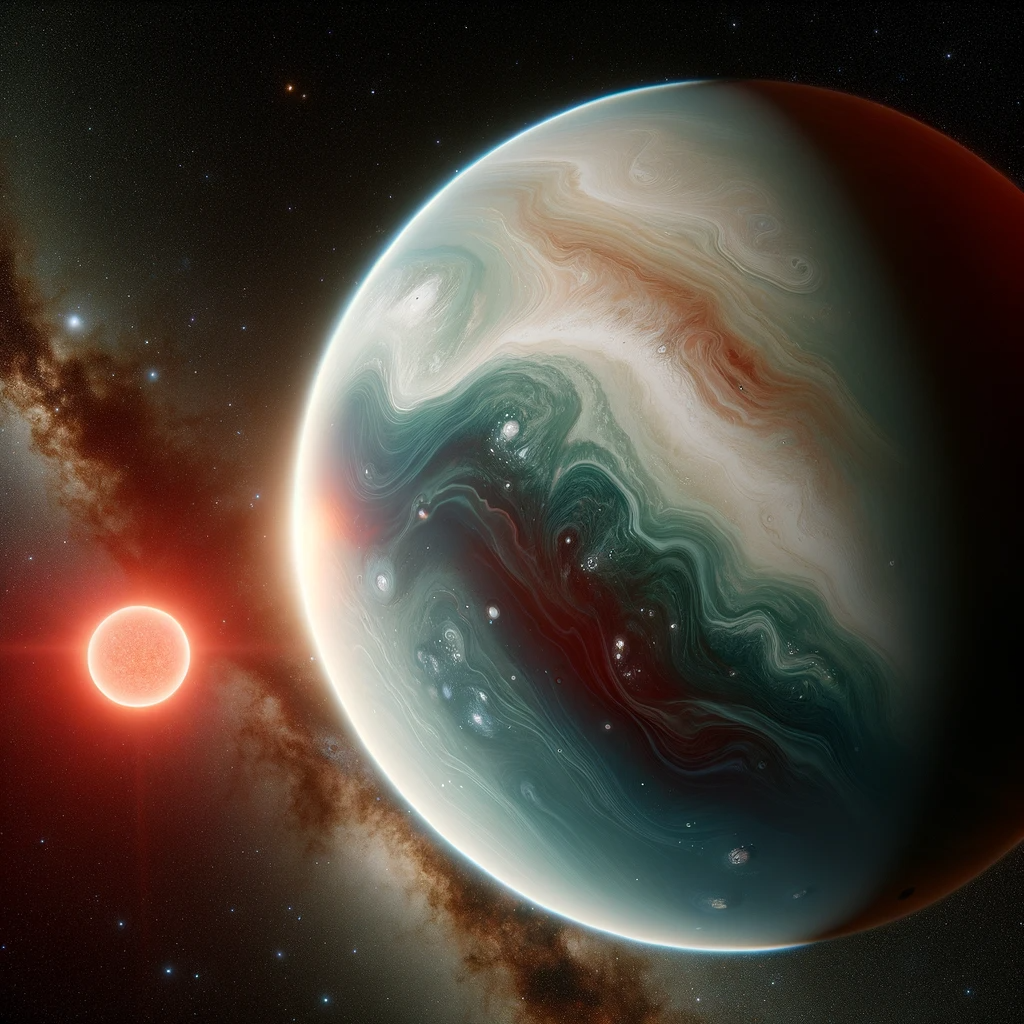
Featured Image: Artist’s Impression of Haumea
 ad*astra daily