- Scientists have unveiled new insights into Europa’s subsurface, revealing variations in porosity and thermal inertia across its icy shell through data from the ALMA observations.
- Thermal anomalies on Europa’s surface correlate with geographical and compositional features, suggesting a dynamic interplay between the moon’s internal processes and external environmental factors.
- These findings enrich our understanding of Europa’s geology and potential habitability, setting a foundation for future exploratory missions like the Jupiter Icy moons Explorer (JUICE) and the Europa Clipper spacecraft.
In a groundbreaking study focused on Jupiter’s moon Europa, scientists have delved into the mysteries lying beneath its icy exterior, revealing significant findings about its subsurface properties. Utilizing data from the Atacama Large Millimeter/submillimeter Array (ALMA), the research team embarked on a detailed examination of Europa’s near-subsurface, spanning depths of approximately 1 to 20 centimeters. This exploration has shed light on the varying degrees of porosity and the corresponding effective thermal inertias across different layers beneath the surface, offering a new lens through which to understand this celestial body.
Europa, known for its intriguing surface features and potential for harboring a subsurface ocean, presents a compelling target for astrobiological research. The study’s findings indicate that the upper 20 centimeters of Europa’s subsurface exhibit a porosity range from 75% to 40%, with noticeable differences between the moon’s leading and trailing hemispheres. These variations in porosity and effective thermal inertia—a measure of a material’s ability to conduct and store heat—reveal a complex interplay between Europa’s internal processes and external influences from Jupiter’s magnetosphere.
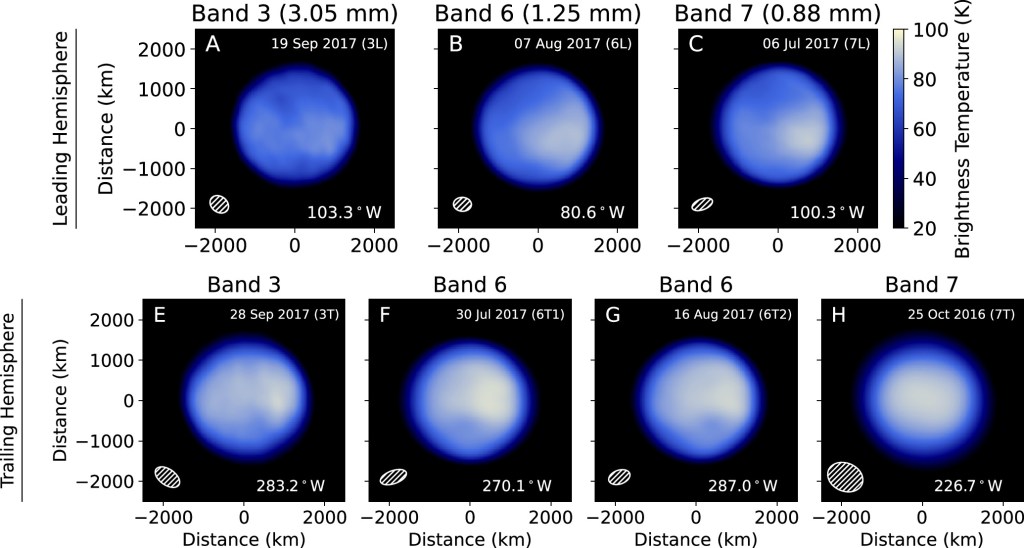
The research team meticulously analyzed thermal anomalies across Europa’s surface, correlating these irregularities with known geographical and compositional features. Warm thermal anomalies were frequently found in proximity to specific landmarks or compositional variances, suggesting a link between surface features and underlying thermal properties. Conversely, cooler temperature anomalies aligned with areas known to contain pure, crystalline water ice, as well as the expansive rays emanating from Pwyll crater. These findings underscore the dynamic nature of Europa’s surface and subsurface, influenced by both endogenic (internal) and exogenic (external) processes.
Moreover, the study’s utilization of ALMA observations at various wavelengths enabled a comprehensive examination of Europa’s subsurface, revealing how its thermophysical properties change with depth and latitude. This approach has not only provided a clearer picture of the moon’s icy shell but also highlighted the potential for future observations to uncover additional insights into Europa’s subsurface characteristics. High-resolution observations at different wavelengths, for instance, could further refine our understanding of the regolith’s compaction and the effects of external processes on Europa’s shallow subsurface.
Europa’s varied terrain and hemispheric asymmetries, accentuated by its ridged plains, chaotic terrain, and the presence of hydrated salts and sulfuric compounds, underscore the moon’s geological youth and tectonic activity. The study adds a new dimension to our understanding of Europa by linking thermal anomalies to both geographic features and compositional differences. This connection between Europa’s surface and subsurface characteristics is crucial for unraveling the moon’s complex geological history and assessing its potential habitability.
As the scientific community looks forward to the upcoming missions to Europa, such as the Jupiter Icy moons Explorer (JUICE) and the Europa Clipper spacecraft, the insights garnered from this study will be invaluable. The detailed analysis of Europa’s subsurface properties not only enriches our understanding of this enigmatic moon but also sets the stage for future explorations, aiming to uncover the secrets lying beneath its icy facade. With each discovery, we move closer to unraveling the mysteries of the solar system’s icy worlds and their potential to support life.
Source: Thelen, Alexander E, et al. “Subsurface Thermophysical Properties of Europa’s Leading and Trailing Hemispheres as Revealed by ALMA.” The Planetary Science Journal, vol. 5, no. 2, 2024, p. 56, dx.doi.org/10.3847/PSJ/ad251c, https://doi.org/10.3847/PSJ/ad251c.
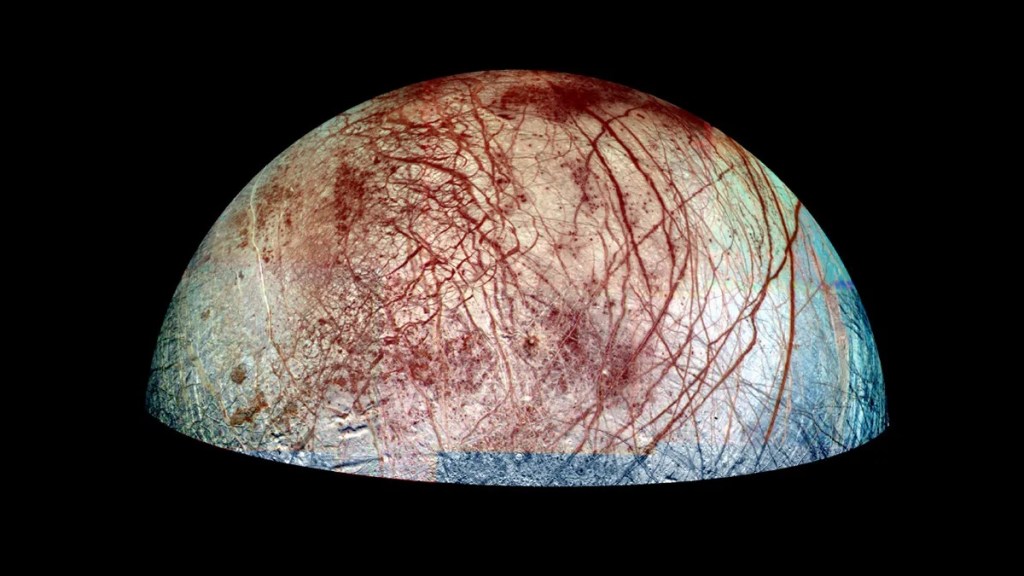
Featured Image: Europa. NASA/JPL/University of Arizona