
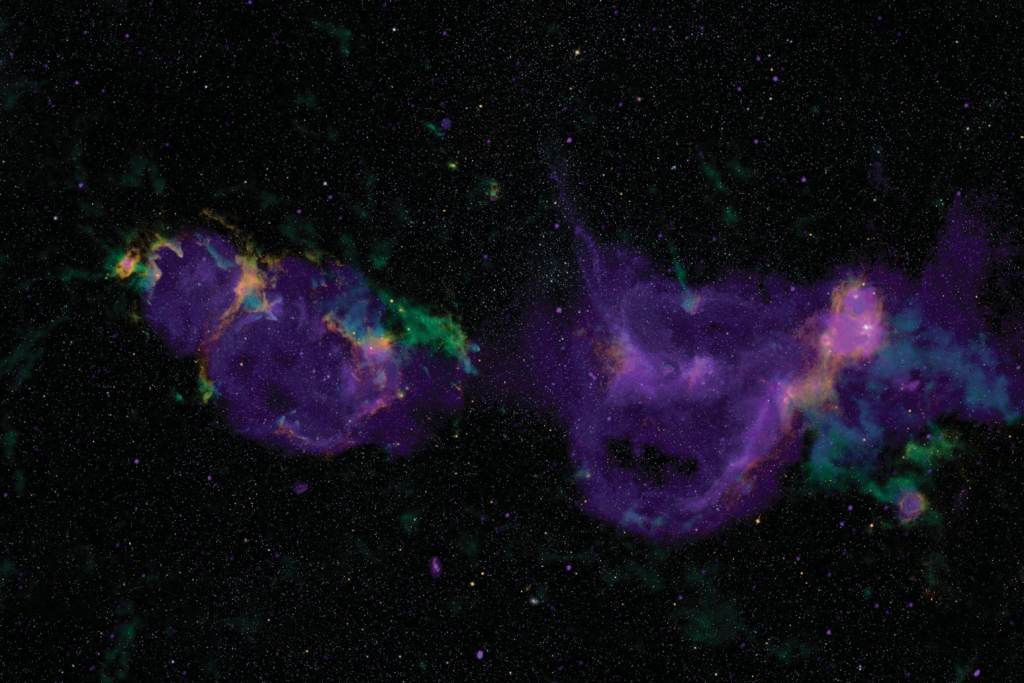
- An in-depth study of the W5-NW star-forming complex reveals evidence that cloud-cloud collisions can trigger the formation of stars and clusters, highlighted by the physical interaction of two clouds fitting together like a key and keyhole.
- Observations of bridging features with intermediate velocities and a skewed V-shaped signature at the collision site support the dynamic process of star formation, further evidenced by an unusual concentration of young stellar objects in the area.
- The study underscores the role of shock compression and magnetic fields, as demonstrated through hydrodynamical and magnetohydrodynamic simulations, in creating dense cores that lead to the birth of new stars, offering insights into the mechanics of cosmic cloud collisions and their impact on galactic star formation.
Astronomers have recently conducted an in-depth study of the W5-NW star-forming complex, uncovering clear signs that collisions between clouds of gas in space can trigger the birth of stars and even entire star clusters. This complex, part of the larger W3/W4/W5 molecular cloud system located in the Perseus spiral arm of the Milky Way, has long intrigued scientists with its active star formation and unique structural features. Utilizing advanced observation techniques and sophisticated analysis algorithms, researchers have now provided compelling evidence linking cloud–cloud collisions (CCC) to the complex mechanisms of star and cluster formation.
The study, anchored in detailed structural and gas kinematic analyses, reveals a dramatic narrative of cosmic proportions. Two clouds within the W5-NW complex, designated as W5-NWa and W5-NWb, were observed to collide, merging their distinct morphologies into an interaction reminiscent of a key fitting into a keyhole. This peculiar configuration, along with a host of bridging features marked by intermediate velocities, forms the cornerstone of evidence for the collision scenario. Particularly, a skewed V-shaped bridging feature detected at the collision site offers a striking visual cue of the dynamic processes unfolding in the depths of space.
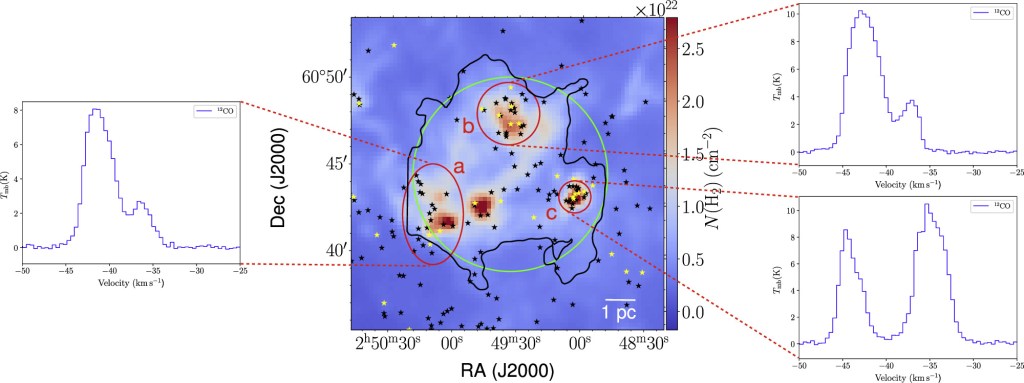
Further reinforcing the notion that cloud collisions are a crucible for new stars, the region boasts an overdensity of Class I and Class II young stellar objects (YSOs). These findings suggest that the tumultuous environment, shaped by the colliding clouds, provides fertile ground for the rapid emergence of new stars, likely triggered by the mechanical forces and shock compression inherent in such cosmic events. This scenario aligns with a growing body of research emphasizing the significant role CCC plays in the galactic star formation narrative.
In addition to the observational breakthroughs, the study draws upon a wealth of theoretical and simulation-based insights. Galactic scale numerical simulations have illuminated the frequent nature of cloud collisions in gas-rich galaxies, highlighting their potential to reshape the cosmic landscape. Hydrodynamical and magnetohydrodynamic (MHD) simulations further unravel the conditions conducive to star formation, pointing to the critical influence of shock compression and magnetic fields in the creation of dense, massive cores from which stars can emerge. These cores, the cradles of nascent stars, owe their existence to the delicate balance between the colliding clouds’ relative velocity and the duration of their interaction within the high-density, shock-compressed region.
Recent observational studies have bolstered the theoretical framework, providing tangible evidence of CCC’s instrumental role in the formation of high-mass stars, super star clusters, and even the singular beauty of O-type stars with surrounding H ii regions. This wealth of empirical data, combined with the nuanced understanding gleaned from simulations, paints a comprehensive picture of the dynamic interplay between cloud collisions and star formation. The case of the W5-NW complex, with its striking visual and kinematic signatures of collision-induced star formation, serves as a compelling testament to the transformative power of cosmic collisions.
As astronomers continue to explore the vast and often enigmatic expanse of our galaxy, studies like the investigation of the W5-NW complex stand as beacons of progress, illuminating the complex processes that govern the birth of stars and the evolution of the cosmos. Through the lens of cloud–cloud collisions, we gain not only a deeper understanding of the mechanisms of star formation but also a broader perspective on the dynamic and ever-changing universe we inhabit.
Source: Issac, Namitha, et al. “Cloud–Cloud Collision and Cluster Formation in the W5NW Complex.” The Astronomical Journal, vol. 167, no. 4, 2024, p. 158, dx.doi.org/10.3847/15383881/ad2847, https://doi.org/10.3847/15383881/ad2847.
Featured Image: W5 Molecular Cloud Complex. Ginsburg et al.
 ad*astra daily