
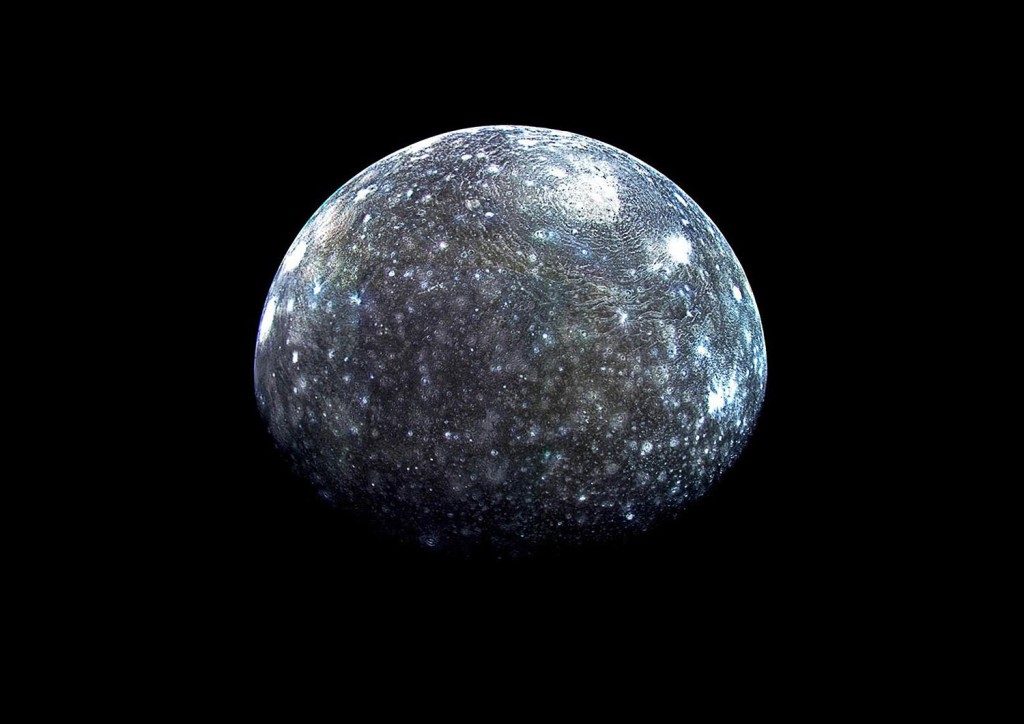
- Groundbreaking observations by the James Webb Space Telescope reveal the presence of CO2 gas across Callisto’s atmosphere, a first for its trailing side, highlighting solid-state CO2 and radiolytic processes.
- Detected spectral features suggest diverse chemical processes, including a strong absorption band potentially tied to CN-bearing organics, differing spatially from CO2, indicating complex surface and atmospheric chemistry.
- These findings, pivotal for understanding carbon chemistry on icy moons, underscore the need for further research ahead of future missions like NASA’s Europa Clipper and ESA’s JUICE spacecraft.
Utilizing the James Webb Space Telescope (JWST), astronomers have unveiled new insights into the atmospheric composition of Callisto, one of Jupiter’s Galilean moons. The research, conducted with the NIRSpec Integrated Field Unit, has revealed the presence of carbon dioxide (CO2) gas across Callisto’s atmosphere, marking the first detection of CO2 gas over the moon’s trailing side.
The study highlights strong absorption bands at 4.25 μm, indicative of solid-state CO2, primarily located at low latitudes near the center of Callisto’s trailing hemisphere. This distribution aligns with expectations of radiolytic production, where magnetospheric plasma interacts with water and carbonaceous compounds on Callisto’s surface. Such interactions suggest a dynamic atmosphere sustained by processes like sputtering, radiolysis, and geological activities, rather than solely by sunlight.
Further, the research identified a 4.38 μm absorption band likely resulting from solid-state 13CO2 and a notable 4.57 μm band, stronger on the leading hemisphere, possibly tied to CN-bearing organics. This latter feature suggests a distinct spatial distribution from that of 12CO2, hinting at diverse origins and accumulation processes on Callisto.
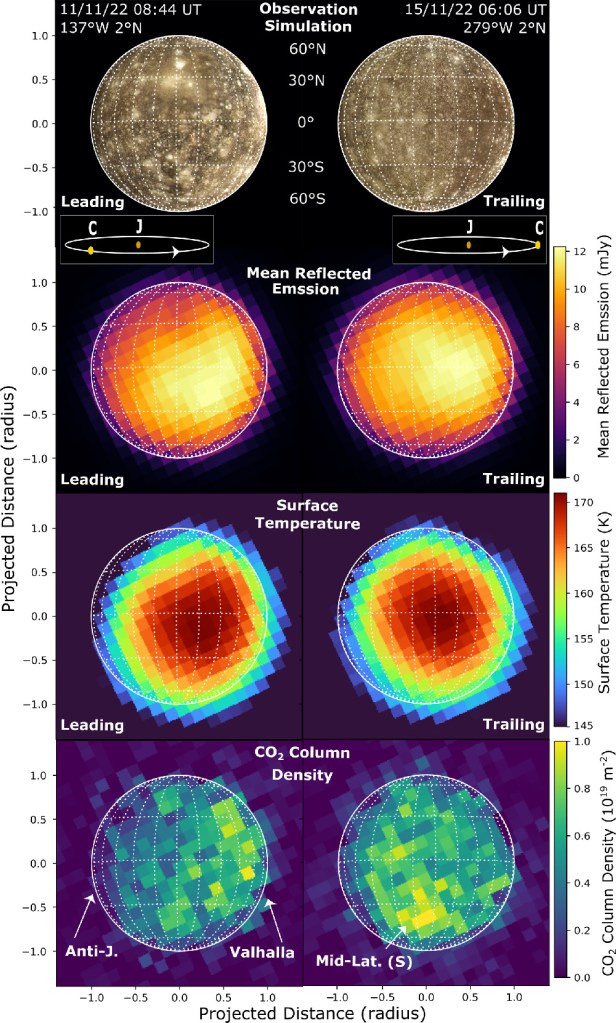
These findings are crucial for understanding the complex carbon chemistry on icy moons, with implications for upcoming missions like NASA’s Europa Clipper and ESA’s JUICE spacecraft. Callisto’s heavily cratered surface, revealing minimal endogenic modification and a history of exogenic influences, offers a unique window into the chemical processes shaping the icy bodies in our solar system.
The JWST’s capabilities have allowed for a detailed analysis of Callisto’s atmosphere, confirming the global presence of CO2 gas and shedding light on the moon’s geological and chemical evolution. The detection of additional spectral features, including those potentially resulting from CO and carbonyl sulfide, underscores the need for further laboratory work and modeling to fully grasp Callisto’s atmospheric dynamics.
This research not only expands our knowledge of Callisto but also demonstrates the JWST’s potential in advancing our understanding of the outer solar system’s icy worlds.
Source: Cartwright, Richard J, et al. “Revealing Callisto’s Carbonrich Surface and CO2 Atmosphere with JWST.” The Planetary Science Journal, vol. 5, no. 3, 2024, p. 60, dx.doi.org/10.3847/PSJ/ad23e6, https://doi.org/10.3847/PSJ/ad23e6.
Featured Image: NASA

 ad*astra daily