
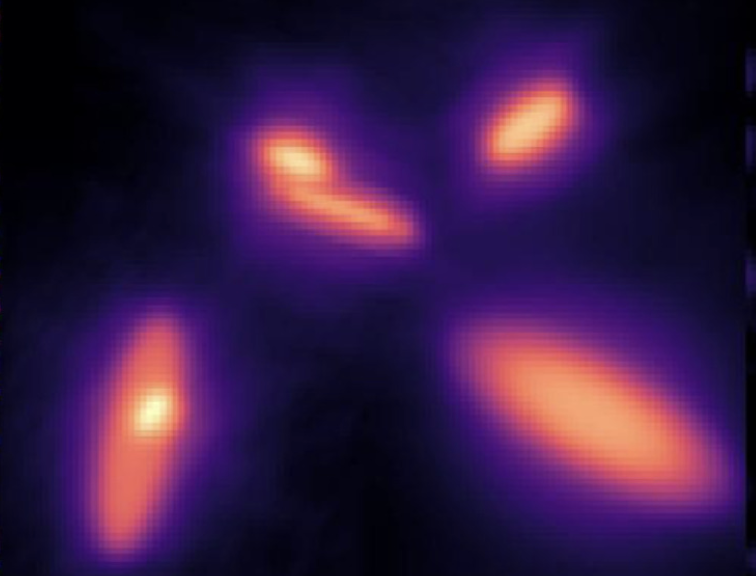
- Astronomers using the Hubble Space Telescope have identified the host galaxy of the Fast Radio Burst FRB 20220610A as part of a compact group at a redshift of z = 1.017, suggesting a rare and novel environment for FRBs linked to star formation.
- The host galaxy is characterized by active star formation, with properties similar to those of star-forming field galaxies at comparable redshifts, potentially indicating the conditions favorable for FRB occurrence.
- Despite the detailed observations, significant excess dispersion measure remains unexplained, highlighting the need for further research to understand the origins and environments of FRBs.
Astronomers have made a new discovery using the Hubble Space Telescope, shedding light on the origins of a Fast Radio Burst (FRB), dubbed FRB 20220610A, which has puzzled scientists since its detection in June 2022. This FRB, which has not been observed to repeat, hails from a galaxy with a redshift of z = 1.017, indicating it occurred when the universe was roughly half its current age.
The imaging revealed seven extended sources within the vicinity of FRB 20220610A, with one being identified as the likely host galaxy. This galaxy is part of a compact group showing signs of interaction, which could influence the phenomena observed. The detailed observations mark this FRB as residing in a star-forming galaxy, with a stellar mass of about 109.7 times that of our Sun, a mass-weighted age of approximately 2.6 billion years, and a star formation rate of around 1.7 solar masses per year.

These findings place the host galaxy in line with the characteristics of star-forming field galaxies at similar redshifts and offer insights into the conditions that might lead to FRBs. The compact galaxy group setting is particularly intriguing, as it suggests a novel and rare environment for the occurrence of FRBs, potentially linked to star formation triggered by galaxy interactions.
Despite the progress, a significant portion of the dispersion measure—a tool used to estimate the distance of FRBs based on the spread of radio wave frequencies—remains unaccounted for, suggesting that further investigations are necessary to fully understand the origins and environment of FRB 20220610A.
This discovery not only adds to our understanding of the environments that can host FRBs but also paves the way for future studies to explore the evolution of these mysterious bursts and their host galaxies across cosmic time. As technology advances and more high-redshift FRBs are detected, astronomers anticipate a richer understanding of the universe’s baryonic content and the nature of FRBs themselves.
Source: Gordon, Alexa C, et al. “A Fast Radio Burst in a Compact Galaxy Group at Z ∼ 1.” The Astrophysical Journal Letters, vol. 963, no. 2, 2024, p. L34, dx.doi.org/10.3847/20418213/ad2773, https://doi.org/10.3847/20418213/ad2773.
Featured Image: Modeling of FRB 20220610A galaxy group. Gordon et al.

 ad*astra daily