
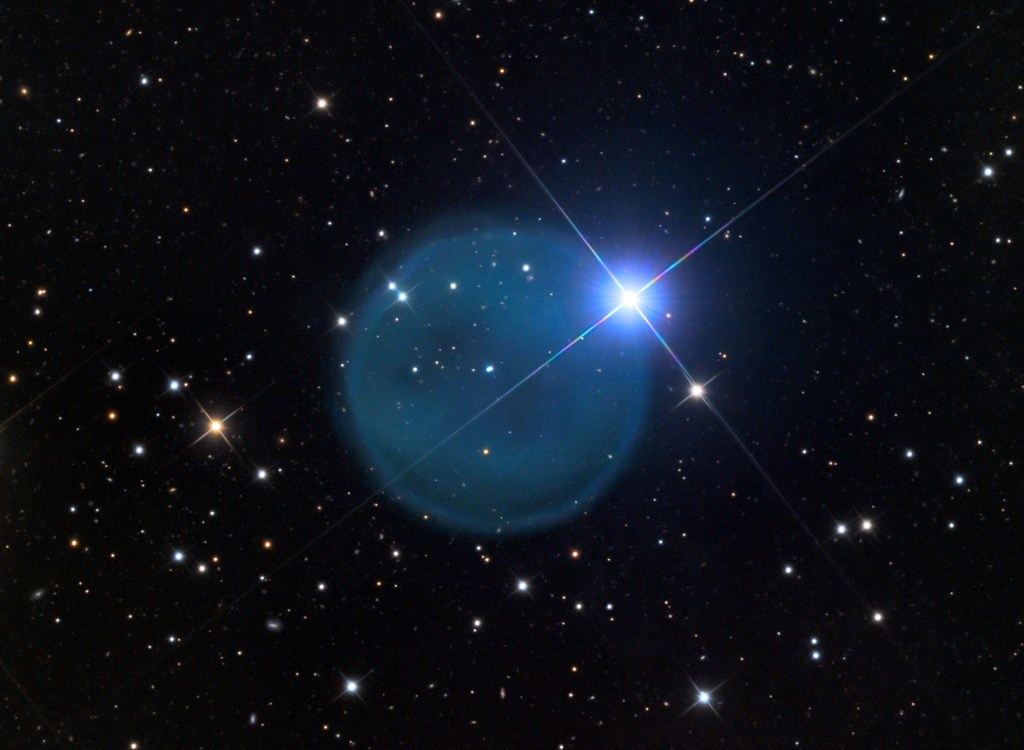
- Researchers using the Hobby-Eberly Telescope have discovered three hydrogen-deficient stars within faint planetary nebulae, significantly advancing our understanding of late-stage stellar evolution.
- The stars, including a Population II Wolf-Rayet star and two new members of the PG1159 class, share similar masses and chemical compositions, highlighting a post-AGB evolutionary sequence from early-K type main sequence stars.
- This study, part of an extensive spectroscopic survey, sheds light on the mechanisms behind hydrogen deficiency in stars and their transformation during the terminal phases of stellar evolution.
In an exciting development, researchers using the state-of-the-art Low-Resolution Spectrograph (LRS2) mounted on the 10-meter Hobby-Eberly Telescope (HET) at McDonald Observatory have identified three enigmatic stars nestled within faint planetary nebulae. These discoveries, part of a comprehensive spectroscopic survey aimed at unraveling the mysteries of faint Galactic planetary nebulae, mark a significant leap forward in our understanding of stellar evolution, particularly in its later stages.
The stars in question exhibit remarkably high effective temperatures exceeding 100,000 K and are characterized by a notable deficiency in hydrogen. Among these, the nucleus of RaMul 2 has been classified as a Population II Wolf-Rayet star, a category known for its strong stellar winds and distinctive spectral lines. This star’s spectral type, denoted as [WC], signifies its unique chemical makeup, rich in carbon and helium, hallmarks of a rare breed of stellar objects.
Meanwhile, the central stars of Abell 25 and StDr 138 have been introduced as new members of the PG1159 class, named after the prototype star PG 1159-035. This class is distinguished by its unusual atmospheric composition, predominantly helium, carbon, and in some cases, oxygen, with almost no trace of hydrogen. The spectral analysis of these stars reveals that they share a similar chemical composition, pointing towards a common origin likely rooted in a late helium-shell flash, a dramatic stellar event that alters the star’s chemical profile.
Intriguingly, all three stars share similar masses, approximately 0.53 solar masses, suggesting they form a sequential trio in the post-Asymptotic Giant Branch (AGB) phase of stellar evolution. This phase represents a period of significant transformation, where stars evolve from the AGB phase, shedding their outer layers to reveal a hot core that will eventually cool down to become a white dwarf. These stars originally hailed from the early-K type main sequence, with an initial mass of about 0.8 solar masses. The study meticulously documents their journey as they fade from a luminosity of about 3000 solar luminosities to a mere 250, alongside a contraction in radius and an increase in surface gravity. This transformation effectively stifles the stellar wind, marking a pivotal shift in their evolutionary trajectory.

The detailed observations carried out with LRS2-B, part of the HET’s second-generation instrumentation, offer a window into the stars’ complex atmospheres and evolutionary paths. The spectrograph’s unique capabilities, splitting light into a spectrum for detailed analysis, have been instrumental in these findings, showcasing the importance of advanced observational tools in contemporary astronomy.
The identification of these stars as part of the PG1159 class expands the known members of this rare group, which now includes 71 objects, 27 of which are associated with planetary nebulae. The genesis of the hydrogen-deficient nature of PG1159 stars is thought to be the result of late thermal pulses, catastrophic events that can occur in the dying stages of a star’s life, leading to a profound transformation in its chemical makeup.
This research not only enriches our catalog of exotic stellar objects but also deepens our insight into the mechanisms driving stellar evolution, especially in its terminal phases. The findings challenge and refine our understanding of how stars like our Sun end their lives, transitioning through phases of dramatic change to emerge as white dwarfs. Furthermore, they hint at the diverse pathways through which stars can lose their hydrogen, involving complex processes such as late thermal pulses or interactions within binary systems.
As the third installment in a series of papers detailing the results of this ambitious spectroscopic survey, this study underscores the critical role of spectroscopy in peeling back the layers of stellar mysteries. By painstakingly cataloging and analyzing the properties of these faint celestial objects, astronomers are piecing together the puzzle of our universe’s stellar evolution, one star at a time. With each discovery, the cosmos reveals a bit more of its intricate tapestry, inviting us to ponder the life cycles of the stars that light up our night sky.
Source: Werner, Klaus, et al. “Spectroscopic Survey of Faint Planetary-Nebula Nuclei III. A [WC] Central Star and Two New PG1159 Nuclei.” ArXiv.org, 2024, arxiv.org/abs/2402.18976.
Featured Image: Abel 33. Adam Block/Mount Lemmon SkyCenter/University of Arizona

 ad*astra daily