
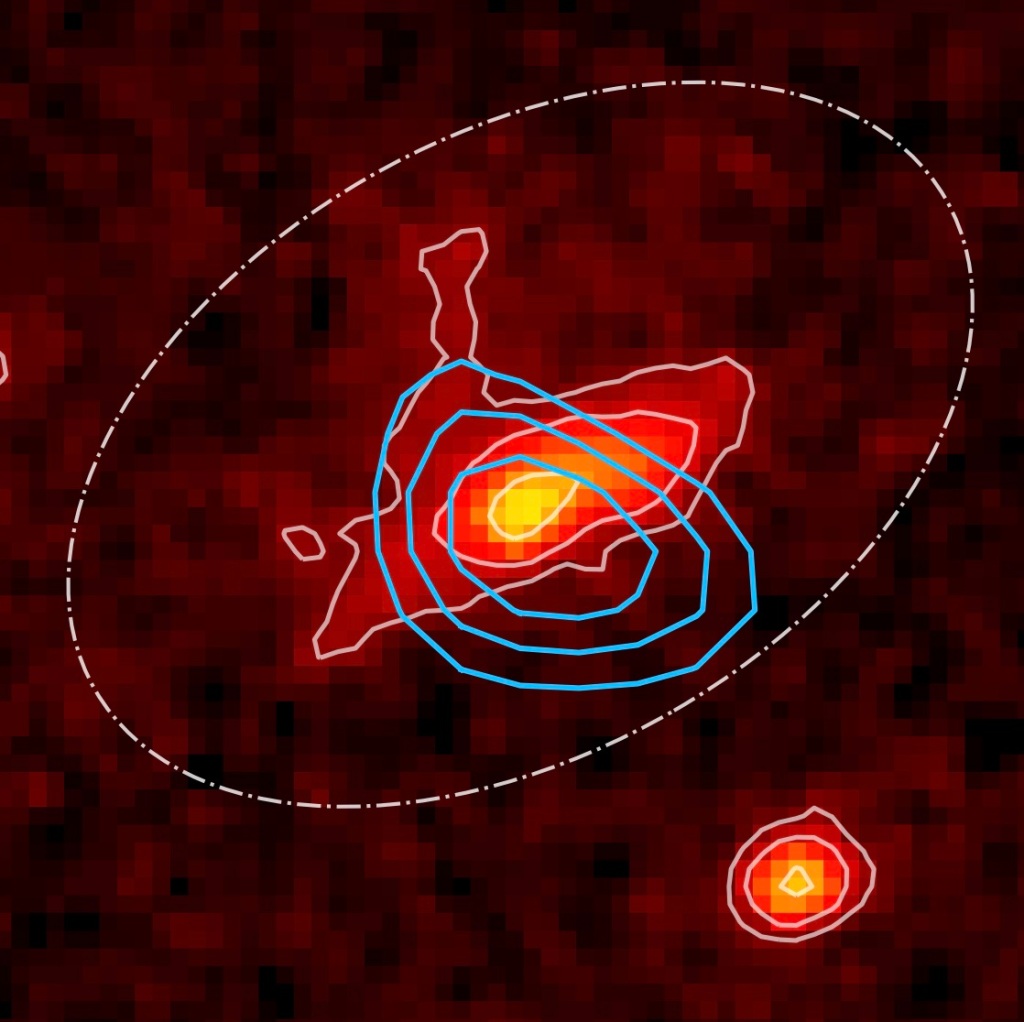
- The James Webb Space Telescope (JWST) has provided the first spatially-resolved morphological analysis of Dusty Star-Forming Galaxies (DSFGs) and a Lyman-break galaxy (LBG) at z = 4.05, revealing diverse galaxy structures from disk-like to clump-dominated forms.
- This study contrasts the galaxies’ near-infrared emissions with their ultraviolet counterparts, highlighting significant dust obscuration and offering new insights into their star formation rates, stellar masses, and internal extinction.
- The findings underscore the critical role of dense cosmic environments in accelerating galaxy growth and evolution, with the JWST’s advanced imaging capabilities opening new avenues for understanding the early universe’s galactic formation processes.
Researchers have utilized the unparalleled capabilities of the James Webb Space Telescope (JWST) to conduct the first-ever spatially-resolved analysis of Dusty Star-Forming Galaxies (DSFGs) and a Lyman-break galaxy (LBG) located in a galactic conglomerate at the astonishing redshift of z = 4.05. These galaxies, situated in the densest corners of the universe, are renowned for their extreme star-formation rates, previously estimated to reach up to 1000 solar masses per year. Such prolific star-forming activity marks them as crucial elements for understanding the mechanisms of galaxy formation and evolution in the nascent universe.
Prior to the deployment of the JWST, the intricate details of these cosmic behemoths’ stellar distributions, particularly those traced by near-infrared emission, remained elusive, obscured by the dust that fuels their star-forming furnaces. The JWST, with its advanced Mid-Infrared Instrument (MIRI), equipped with a suite of filters ranging from F560W to F1800W, has now pierced through this veil, revealing the rest-frame near-infrared glory of these galaxies. This study represents a monumental stride in our quest to map the cosmic tapestry of the early universe, offering unprecedented insight into the mature stellar components of these galaxies for the first time.
This detailed morphological analysis has unveiled a stunning variety in the structures of these galaxies, ranging from disc-like configurations to compact and clump-dominated forms. Such diversity in galactic architecture provides invaluable clues to the myriad paths galaxies may take through the cosmic web of evolution. Moreover, this investigation has highlighted a striking contrast between the galaxies’ near-infrared and ultraviolet emissions. While the former unveils the mature stellar population, the latter is predominantly diffused and, in some cases, noticeably offset due to the intense dust obscuration that characterizes these star-forming regions.
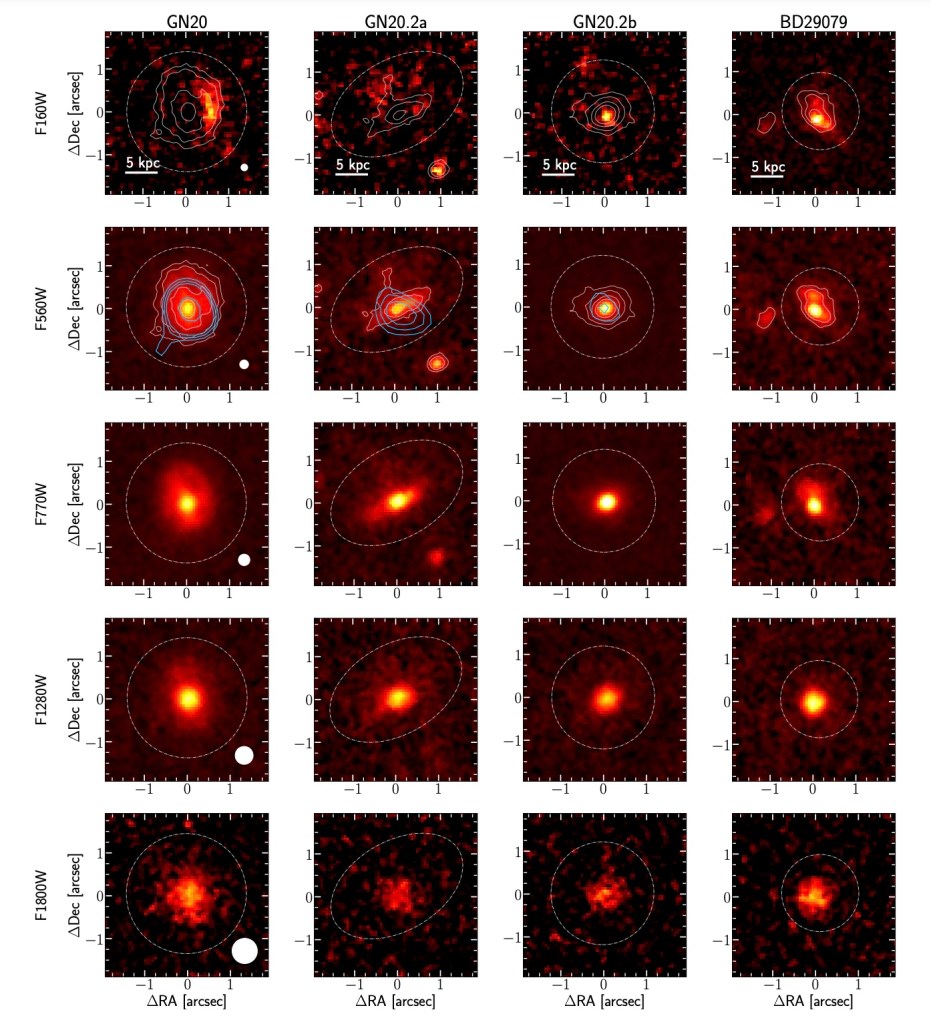
Furthermore, the spectral energy distribution (SED) fitting technique employed in this study has extrapolated critical physical properties of these galaxies, including their massive star-formation rates, substantial stellar masses, and significant levels of internal extinction. Among the galaxies studied, GN20 emerges as a star-forming colossus, dominating its cosmic neighborhood with a star-formation rate of approximately 2500 solar masses per year. Conversely, GN20.2b is distinguished by its towering stellar mass, indicating a more advanced evolutionary stage among its peers.
This comprehensive analysis not only sheds light on the individual characteristics of these galaxies but also places them within the broader context of cosmic evolution. The findings suggest that the dense environments in which these galaxies reside play a pivotal role in accelerating their growth and star-forming activities. Such environments, ripe with the potential for mergers and enriched with vast halos of dark matter, provide the perfect crucible for the birth of new stars at a frenetic pace.
Moreover, the comparison of these DSFGs with others located in less dense regions of the universe reveals that those within cosmic overdensities exhibit significantly larger effective radii, suggesting a rapid expansion facilitated by their environment. This observation underscores the influence of galactic surroundings on shaping the physical characteristics and evolutionary trajectories of galaxies.
The pioneering work enabled by the JWST’s MIRI instrument marks a milestone in our understanding of the universe’s early epochs. By unraveling the detailed structures and physical properties of DSFGs and LBGs in overdense regions, this research provides a window into the processes that governed galaxy formation and evolution during the universe’s infancy. As we continue to gaze deeper into the cosmos with ever-more sophisticated tools, the mysteries of the early universe gradually yield to the relentless pursuit of knowledge, offering glimpses into the cosmic dawn that shaped the vast, starry expanse we call home.
Source: Gómez, A. Crespo, et al. “JWST/MIRI Unveils the Stellar Component of the GN20 Dusty Galaxy Overdensity at Z=4.05.” ArXiv.org, 28 Feb. 2024, arxiv.org/abs/2402.18672.
Featured Image: Gómez et al.

 ad*astra daily