
- ALMA observations of 61 protostars in the Orion Nebular’s molecular clouds reveal dust polarization and outflow emissions, with 16 showing self-scattering indicative of early grain growth in protostellar disks.
- The study classifies protostellar magnetic fields into three morphologies—standard-hourglass, rotated-hourglass, and spiral—highlighting the complex dynamics between magnetic fields, gravity, and protostellar outflows.
- Approximately 40% of the protostars exhibit magnetic fields perpendicular to their outflows, suggesting a structured relationship, while others show a random orientation or strong rotational motions affecting the magnetic field morphology.
An international team of astronomers has utilized the unparalleled capabilities of the Atacama Large Millimeter/submillimeter Array (ALMA) to carry out sophisticated 870 μm polarimetric observations across a sample of 61 protostars nestled within the vast expanse of the Orion Nebula’s molecular clouds. This ambitious study, boasting a resolution of approximately 400 astronomical units (AU)—equivalent to the average distance from the Earth to the Sun—has illuminated the intricate processes at play in the early stages of star formation.
The core of this new research lies in the detection of dust polarization and outflow emissions in 56 of the observed protostars. Remarkably, in 16 instances, the observed polarization patterns are attributed to self-scattering phenomena, suggesting that grain growth and disk formation commence much earlier in the protostellar phase than previously recognized. This revelation is particularly pronounced in several Class 0 sources, the youngest classification of protostars, indicating that significant grain growth is already underway in these nascent disks.
The study’s analysis extended to the examination of the magnetic fields (B-fields) surrounding these protostars. Through detailed observation, the researchers have classified the B-fields into three principal morphologies: the standard-hourglass shape, indicative of a magnetic field that narrows at the center much like the waist of an hourglass; the rotated-hourglass configuration, where the axis of the hourglass shape aligns perpendicularly to the direction of outflow, suggesting a dynamic interplay between the magnetic field and the protostellar materials; and the spiral morphology, which evokes the image of a magnetic field being twisted by the rotational motions of the surrounding protostellar envelope.
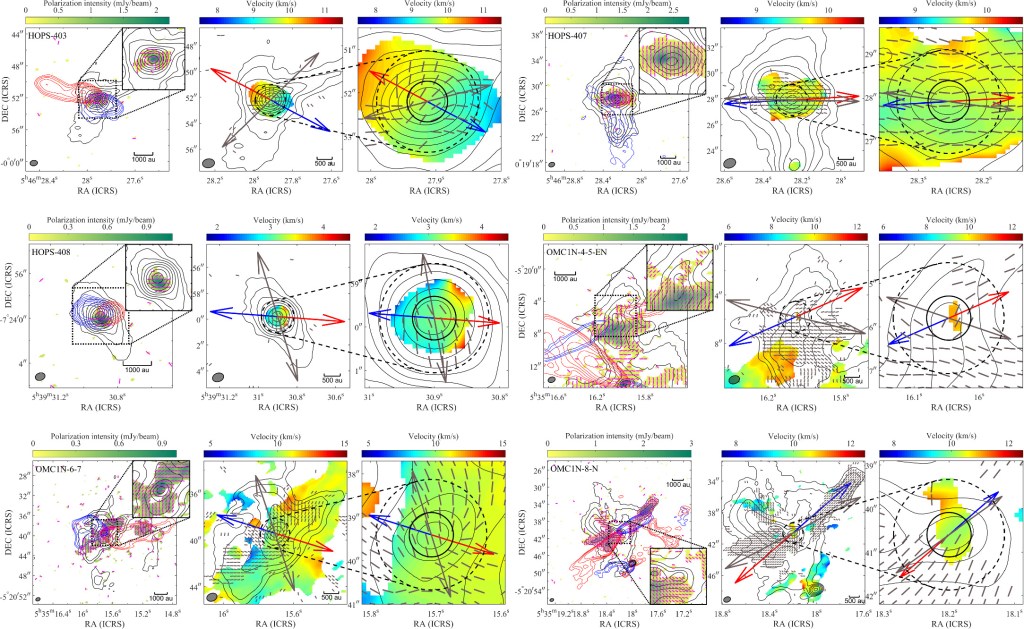
A significant finding of this study is that approximately 40% of the protostars display a mean magnetic field direction that aligns perpendicularly to their outflow directions over spatial scales of several hundred to a few thousand astronomical units. This orientation suggests a structured, potentially harmonious relationship between the magnetic fields and the protostellar outflows. Conversely, the orientation in the remainder of the sample appears to be random, pointing to a more complex set of dynamics influenced by the protostars’ varied morphologies.
Further enriching this study is the classification of protostars based on the velocity gradients of their surrounding envelopes, as observed through C17O (3–2) emission. This classification divides the protostars into three groups: those with velocity gradients perpendicular to the outflow, those with non-perpendicular gradients, and those with unresolved gradients. Intriguingly, in cases where the velocity gradient is perpendicular to the outflow, the magnetic field lines also tend to align perpendicularly, with many exhibiting a rotated hourglass morphology. This suggests that in these systems, the magnetic field’s influence is overwhelmed by the forces of gravity and angular momentum.
On the other hand, spiral-like magnetic fields are predominantly associated with envelopes exhibiting large velocity gradients. This observation implies that the rotational motions within these systems are sufficiently strong to twist the magnetic field lines, resulting in a helical B-field morphology. Notably, all protostars characterized by a standard-hourglass magnetic field morphology show no significant velocity gradient, a phenomenon likely due to the effect of magnetic braking, which efficiently carries away angular momentum, preventing the formation of a centrifugally supported disk.
This extensive study, part of the B-field Orion Protostellar Survey (BOPS), not only advances our understanding of the complex role of magnetic fields in star formation but also highlights the intricate interplay between magnetic fields, gravity, and angular momentum in shaping the early stages of stellar evolution. The findings from the Orion molecular clouds, one of the closest and most studied high-mass/intermediate-mass star-forming regions, offer invaluable insights into the typical conditions under which solar-type stars, including our Sun, form within the Milky Way galaxy.
Source: Huang, Bo, et al. “On the Magnetic Field Properties of Protostellar Envelopes in Orion.” The Astrophysical Journal Letters, vol. 963, no. 1, 2024, p. L31, dx.doi.org/10.3847/20418213/ad27d4, https://doi.org/10.3847/20418213/ad27d4.
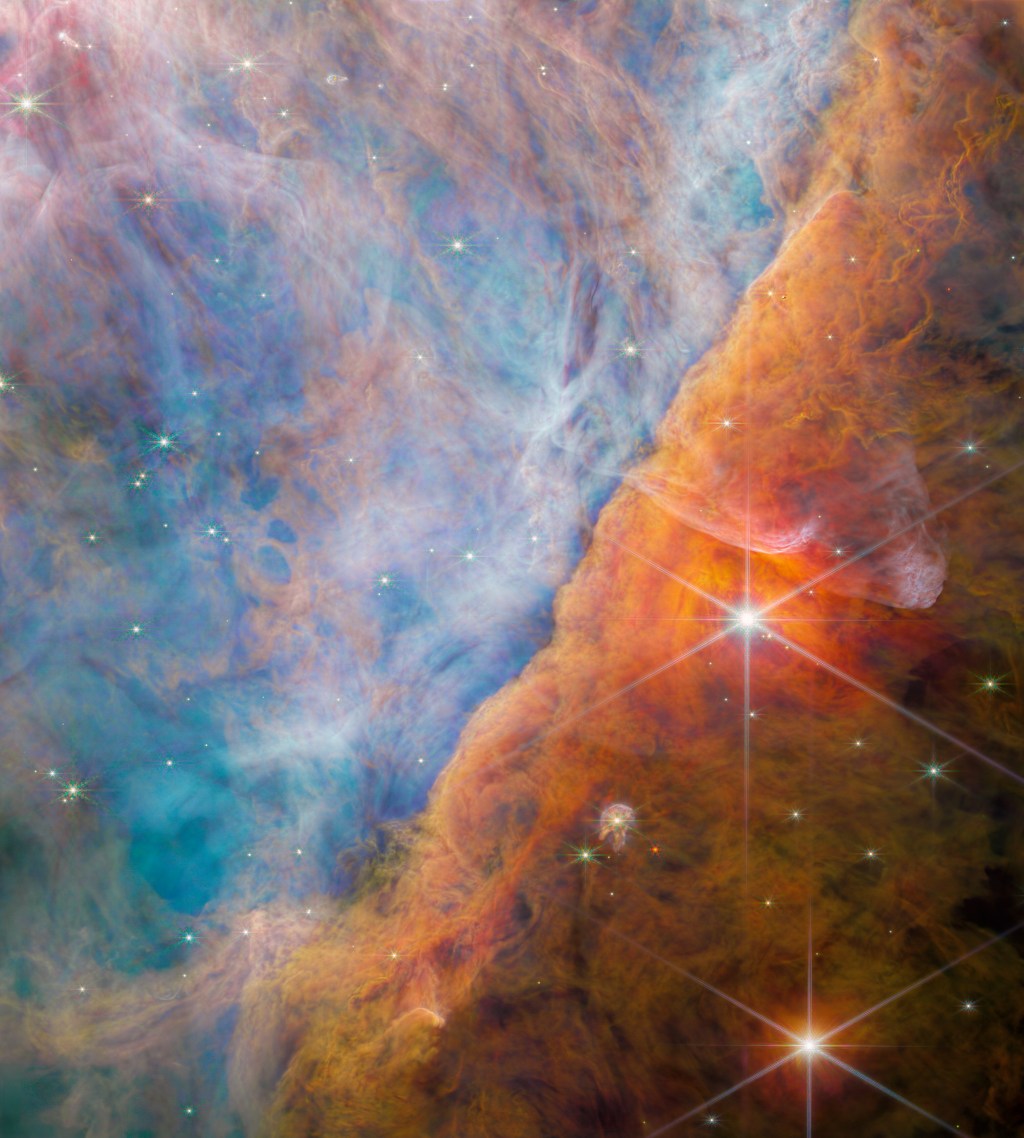
Featured Image: ESA/Webb, NASA, CSA, M. Zamani (ESA/Webb), the PDRs4All ERS Team

 ad*astra daily