
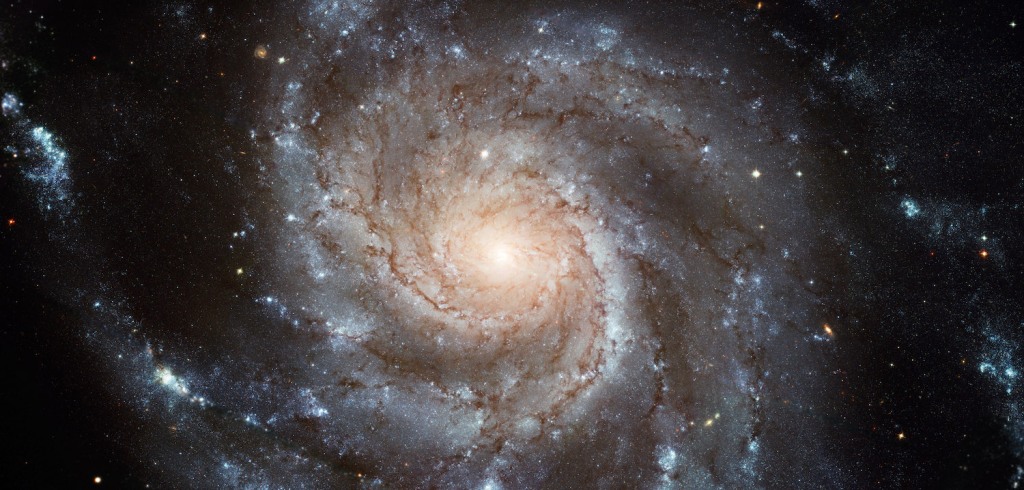
- Recent Chandra-ACIS observations of Supernova 2023ixf in galaxy M101 have revealed high-temperature plasma from circumstellar interaction, with significant absorption by material near the supernova, indicating dynamic changes in the surrounding environment post-explosion.
- The study observed a decrease in absorption column density over time and detected the Fe Kα fluorescent line, suggesting the presence of cold material near the supernova initially, which dissipates as the circumstellar material interacts with the supernova’s shockwave.
- These findings highlight the critical role of mass loss in the final evolutionary stages of supernova progenitors, offering insights into the processes leading up to the explosion and providing a clearer understanding of the life cycles of massive stars.
In an exciting development for the field of astrophysics, recent observations made with the Chandra Advanced CCD Imaging Spectrometer (ACIS) have provided unprecedented insights into Supernova 2023ixf, located in the nearby galaxy M101. Recorded on the 13th and 86th days following the explosion, these observations have pierced through the cosmic veil, revealing the intense interactions between the supernova and its surrounding circumstellar matter. This interaction has manifested as high-temperature plasma within the forward shocked region, a clear testament to the violent processes at play in the aftermath of a stellar explosion.
The scientists behind this groundbreaking study have successfully characterized the absorption column density at both observational epochs with Chandra, discovering that it significantly surpasses the anticipated levels attributed to the Galactic and host galaxy’s absorption. This excess absorption is ascribed to the circumstellar material in the immediate vicinity of SN 2023ixf, offering a rare glimpse into the dense material surrounding a supernova shortly after its birth. The evolution of the column density, which declines in a manner inversely proportional to time squared from day 4 to day 13 and then shifts to a linear time-inverse relationship, provides critical clues about the changing environment around the supernova.
Moreover, the observation of the Fe Kα fluorescent line at 6.4 keV on the 13th day post-explosion signifies the presence of cold material close to the supernova, a feature that conspicuously vanishes by day 86. This disappearance aligns with a sevenfold decrease in the column density, further supporting the dynamic nature of the circumstellar interaction. Through meticulous analysis, the research team has inferred that the progenitor of SN 2023ixf underwent a steady mass-loss rate in the years preceding the explosion, shedding light on the evolutionary path that led to this cataclysmic event.
Understanding and mapping the progenitors of core-collapse supernovae (CCSNe) to their explosive demises remains one of the most compelling challenges in stellar astronomy. The relationship between CCSNe and their massive progenitors hinges on comprehending the stellar mass loss during the final evolutionary stages. This mass loss, which forms the circumstellar material (CSM) enveloping the star, can dramatically influence the observable properties of a supernova. Recent developments in this field have highlighted that most progenitors experience enhanced mass loss shortly before explosion, a phenomenon supported by observational evidence through “flash” spectroscopy.
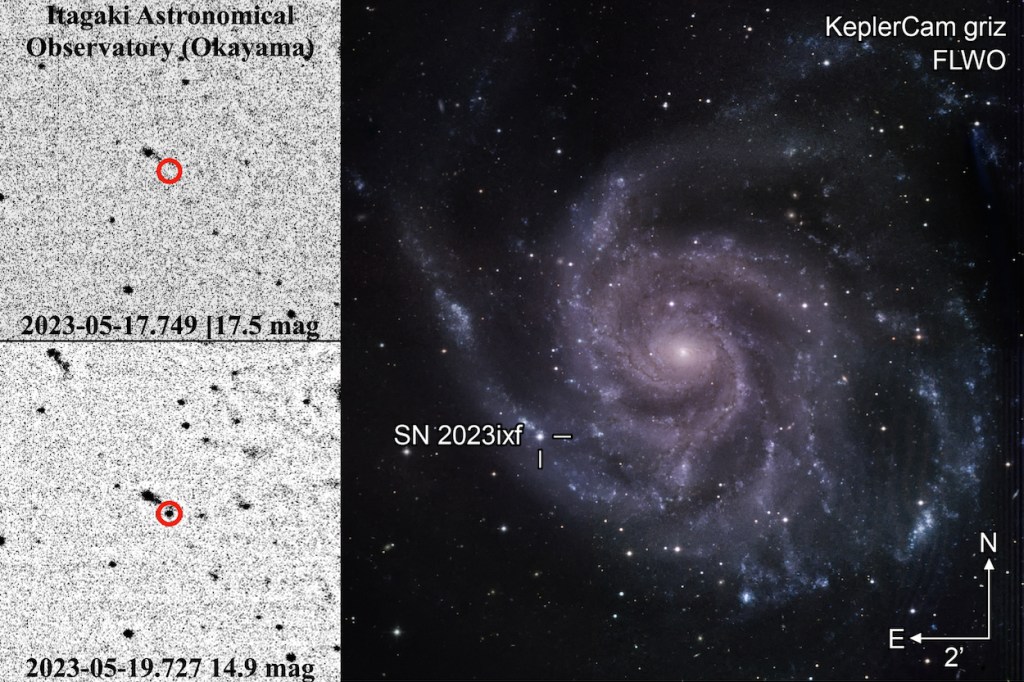
SN 2023ixf, the closest Type II Supernova observed in decades, presents an exceptional opportunity to delve into these phenomena in unprecedented detail. Discovered in M101 by an amateur astronomer, this supernova has been the subject of intense scrutiny, further classified and analyzed through various observational campaigns across multiple wave bands. The pre-explosion data, revealing the progenitor to be a red supergiant nestled in a dusty region, along with post-explosion analyses, have painted a comprehensive picture of the mass and life cycle of the progenitor star.
The optical light curve of SN 2023ixf, characterized by a sharp ascent to its peak followed by a plateau and subsequent decay, alongside spectral data revealing prominent flash features, underscores the complex interplay between the supernova and its CSM. The early X-ray and radio detections post-explosion have complemented these observations, offering a multifaceted view of the event’s aftermath. The varying estimates of mass-loss rates derived from different methodologies underscore the intricacies of the processes leading up to the explosion.
These Chandra X-ray observations of SN 2023ixf underscore the vital role of circumstellar interactions in the life cycle of supernovae, offering invaluable insights into the mass-loss processes of massive stars in the lead-up to their ultimate demise. As SN 2023ixf continues to be monitored in the coming years, it is anticipated that further studies will illuminate our understanding of how massive stars evolve into CCSNe, marking a significant advancement in our quest to unravel the mysteries of stellar evolution and death.
Source: Chandra, Poonam, et al. “Chandra’s Insights into SN 2023ixf.” The Astrophysical Journal Letters, vol. 963, no. 1, 2024, p. L4, dx.doi.org/10.3847/20418213/ad275d, https://doi.org/10.3847/20418213/ad275d.
Featured Image: M101. Canada-France-Hawaii Telescope/J.-C. Cuillandre/Coelum; NOAO Image: G. Jacoby, B. Bohannan, M. Hanna/NOAO/AURA/NSF]

 ad*astra daily