
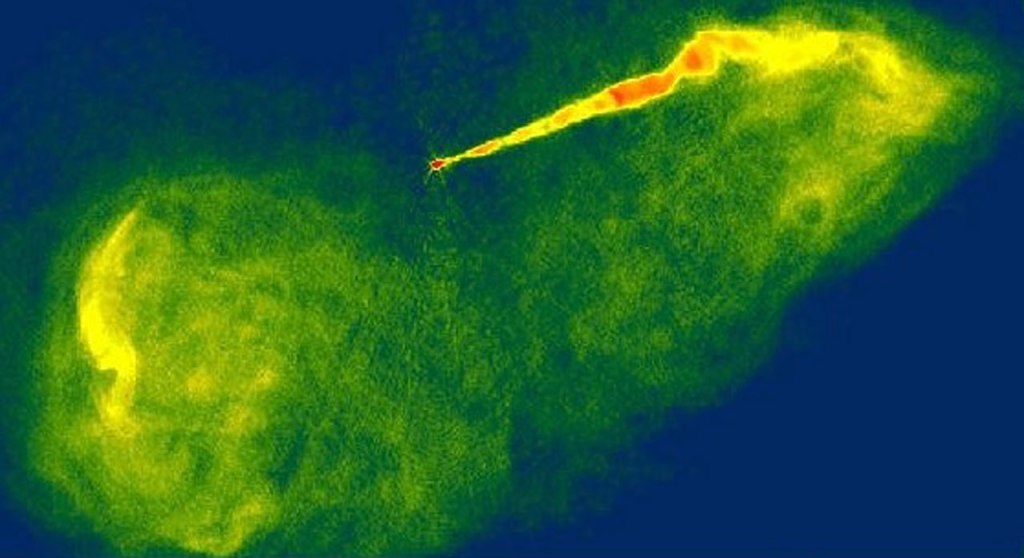
- Recent observations by the Event Horizon Telescope (EHT) and the Global Millimeter VLBI Array (GMVA) have provided new insights into the supermassive black hole at the center of Messier 87 (M87), revealing detailed structures that enhance our understanding of accretion and jet formation.
- The collaborative findings highlight a core-knots structure and jet features at different frequencies, indicating the same phenomena are observed at both 86 GHz and 230 GHz, suggesting a significant step forward in understanding black hole environments.
- These studies underscore the importance of utilizing all available baseline data, including ultrashort baselines, for detecting faint structures around black holes, marking a milestone in the exploration of the universe’s most mysterious phenomena.
In a recent series of observations, astronomers have achieved new insights into the supermassive black hole at the heart of Messier 87 (M87), shedding light on the complex processes of accretion and jet formation in one of the universe’s most enigmatic objects. Through a meticulous reanalysis of the Event Horizon Telescope’s (EHT) data at 230 GHz and the latest findings from the Global Millimeter VLBI Array (GMVA) at 86 GHz, scientists have unveiled detailed structures within the black hole’s vicinity, offering unprecedented clarity on the phenomena surrounding black holes.

The supermassive black hole at the center of the Messier 87 galaxy (M87) is one of the most studied and significant astronomical objects in the universe, primarily due to its massive size, relatively close proximity to Earth, and the remarkable jet of material it ejects. Located in the Virgo Cluster, approximately 53 million light-years from Earth, M87’s black hole presents a unique opportunity for scientists to study the dynamics of black holes and their effects on their surrounding environments.
The EHT’s observations, initially capturing the world’s attention with the first-ever image of a black hole’s shadow in 2019, have been complemented by the GMVA’s findings, which spatially resolved the core of M87 at a lower frequency. This synergy between the two frequencies has revealed a fascinating core-knots structure and jet features, marking a significant step forward in our understanding of black holes.
At the heart of these observations is the identification of two bright regions within the core at 86 GHz, which align with the triple structure of core, knot, and west knot seen at 230 GHz. This alignment suggests that both observations are capturing the same features, despite their differences in frequency. Additionally, the studies noted protrusions on both the southern and northern sides of the core, hinting at possible inflows or outflows related to the black hole’s accretion disk.
The implications of these findings are profound, as they not only offer a glimpse into the mechanisms of jet formation but also underscore the importance of using all available baseline data, including ultrashort baselines, to detect faint structures around black holes. The EHT’s high-frequency observations, coupled with the GMVA’s detailed imaging, have together provided a clearer picture of M87’s core and its associated jet, marking a milestone in the ongoing exploration of our universe’s most mysterious phenomena.
This collaborative effort between the EHT and GMVA highlights the critical role of international cooperation and technological innovation in advancing our understanding of the cosmos. As astronomers continue to refine their techniques and analyze new data, the future promises even deeper insights into the workings of black holes and the cosmic ballet of matter and energy that surrounds them.
Source: Miyoshi, Makoto, et al. “The Jet and Resolved Features of the Central Supermassive Black Hole of M87 Observed with EHT in 2017—Comparison with the GMVA 86 GHz Results.” The Astrophysical Journal Letters, vol. 963, no. 1, 2024, p. L18, dx.doi.org/10.3847/20418213/ad250e, https://doi.org/10.3847/20418213/ad250e.
Featured Image: National Radio Astronomy Observatory/National Science Foundation



 ad*astra daily