
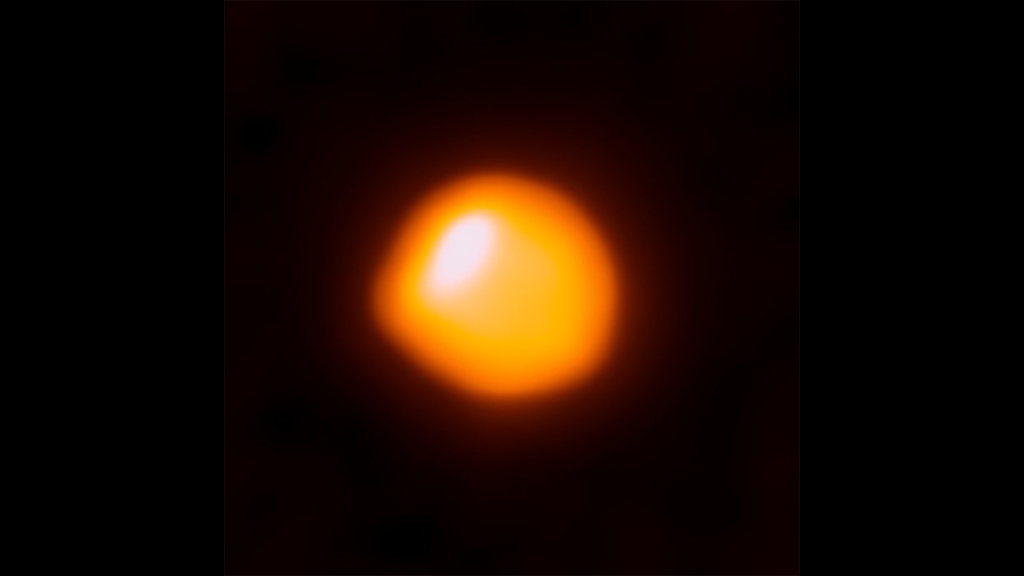
A new study has cast doubts on the prevailing theory that Betelgeuse, one of the closest red supergiants to Earth, is rapidly rotating. Recent observations from the Atacama Large Millimeter/submillimeter Array (ALMA) showing a dipolar velocity field on Betelgeuse’s surface had led scientists to infer a rotation rate significantly higher than what single-star evolution models predict. This discrepancy fueled speculation that Betelgeuse might be a binary merger product.
However, researchers are now proposing an alternative explanation. They suggest that the observed velocity field could be the result of large-scale convective motions, rather than actual rotation. This theory is supported by advanced 3D simulations, which, when postprocessed to predict ALMA observations, show a high likelihood of misinterpreting convective motions as evidence of rapid rotation.
Betelgeuse, also known as Alpha Orionis, is a prominent red supergiant star located in the constellation of Orion, making it one of the largest and most luminous stars visible to the naked eye. Situated approximately 700 light-years away from Earth, Betelgeuse is nearing the end of its life cycle and is expected to explode as a supernova within the next million years—a blink of an eye in cosmic terms. This massive star is renowned for its distinct reddish hue and has been the subject of intense study due to its significant size, brightness variability, and the role it plays in our understanding of the lifecycle of massive stars. Betelgeuse’s variability, including its recent dramatic dimming and rebrightening event, continues to intrigue astronomers and spark studies aimed at uncovering the mysteries of stellar evolution and the processes leading up to supernovae.
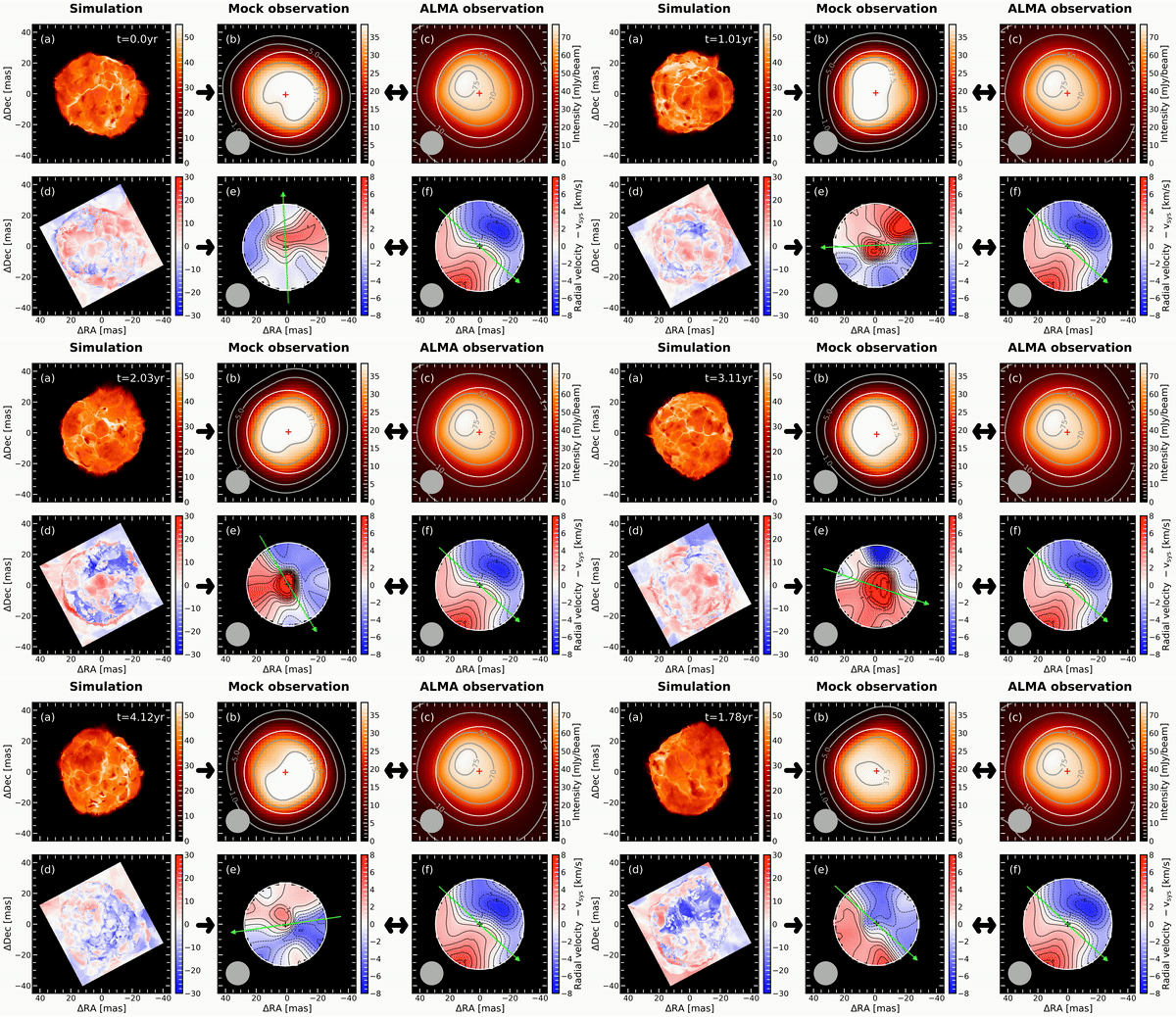
The recent study emphasizes the need for further observations to conclusively determine Betelgeuse’s rotation status. Such data is crucial not only for understanding the specific case of Betelgeuse but also for shedding light on the late evolutionary stages of massive stars, which are key to the formation of supernovae and gravitational-wave sources. Despite historical theories suggesting that cool evolved stars like red supergiants should exhibit slow surface rotation rates, observations across the Hertzsprung–Russell diagram have revealed exceptions, prompting a reevaluation of stellar evolution models.
Betelgeuse’s behavior has been under intense scrutiny, especially following its unexpected dimming and subsequent rebrightening in recent years. This study adds another layer of complexity to our understanding of such stellar giants, challenging assumptions and opening the door to new interpretations of astronomical data.
Researchers call for more high-resolution ALMA observations to further investigate the star’s rotation and the dynamics of its atmosphere. The outcomes of this research could significantly impact our comprehension of stellar physics, particularly the mechanisms driving the evolution and end-of-life stages of massive stars.
Source: Ma, JingZe, et al. “Is Betelgeuse Really Rotating? Synthetic ALMA Observations of Largescale Convection in 3D Simulations of Red Supergiants.” The Astrophysical Journal Letters, vol. 962, no. 2, 2024, p. L36, dx.doi.org/10.3847/20418213/ad24fd, https://doi.org/10.3847/20418213/ad24fd.
Featured Image: ALMA (ESO/NAOJ/NRAO) / E. O’Gorman/P. Kervella

 ad*astra daily