
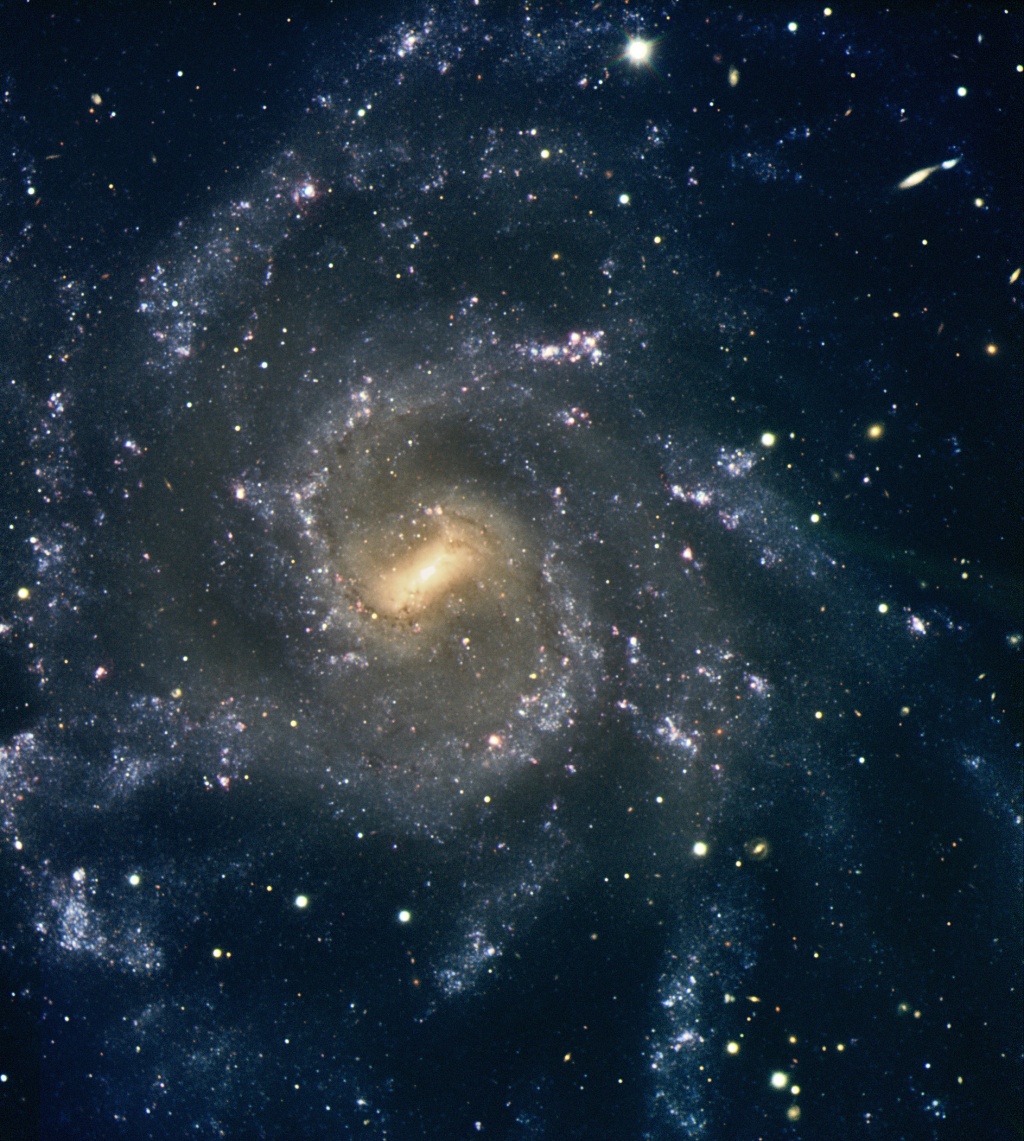
- Astronomers have discovered two ultraluminous X-ray sources in the spiral galaxy NGC 7424, with luminosities about 10,000 times greater than the Sun’s total power output, challenging current theories of stellar evolution and accretion.
- Advanced astrometric techniques identified X-1 as a B8 supergiant star and X-2 within a star-forming region, with both sources showcasing phenomena such as X-ray photo-ionization, which significantly impacts their environments.
- The study of X-1 and X-2, including their optical counterparts, surrounding stellar populations, and a mysterious radio source near X-2, highlights the role of ultraluminous X-ray sources in advancing our understanding of supercritical accretion and cosmic evolution.
In a recent study focusing on the spiral galaxy NGC 7424, astronomers have made significant discoveries regarding two ultraluminous X-ray sources, designated as 2CXO J225728.9−410211 (X-1) and 2CXO J225724.7−410343 (X-2). These sources have exhibited X-ray luminosities reaching approximately 10^40 erg s^-1, challenging existing theories of stellar evolution and accretion processes.
To understand X-rays on this scale, the total power output of our Sun, across all types of electromagnetic radiation, not just X-rays, is about 3.8 times 10^33 erg/s (or 380 billion billion megawatts). This means an X-ray luminosity like that of NGC 7424’s X-1 and X-2 is about 10,000 times the total power output of the Sun. In other words, an ultraluminous X-ray source emits in X-rays alone as much energy every second as 10,000 Suns do across all forms of electromagnetic radiation.
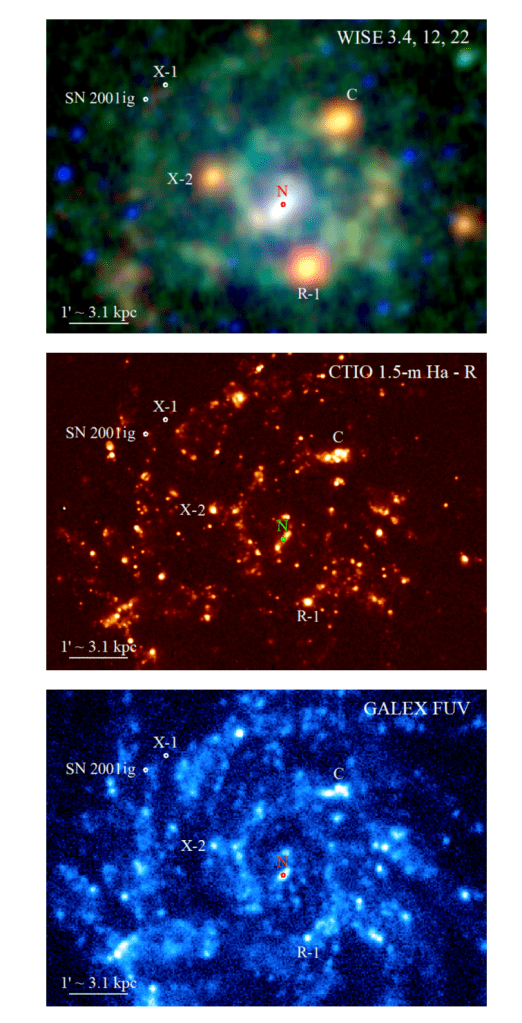
Utilizing advanced astrometric techniques that combine Australia Telescope Compact Array and Gaia data, researchers successfully pinpointed the optical counterparts of these celestial objects. X-1 is identified as a solitary B8 supergiant star with an estimated mass of 9 solar masses and an age of about 30 million years. On the other hand, X-2 is situated within a bustling star-forming region, spanning roughly 100 by 150 parsecs, and is surrounded by young star clusters and ionized gas.
Spectroscopic observations from the Very Large Telescope revealed a spatially extended region of He II λ4686 emission around X-2, indicative of X-ray photo-ionization, a characteristic feature of ultraluminous X-ray sources (ULXs). This phenomenon aligns X-2 with other known photo-ionized ULX nebulae, such as those around Holmberg II X-1 and NGC 5408 X-1, highlighting the significant impact these sources have on their environments.
A strong, unresolved radio source with a steep spectrum was detected, suggesting alternative physical scenarios for the radio emissions. This study also utilized WISE data to assess the reddening of the star-forming clump surrounding X-2, providing critical insights into the interstellar medium’s properties.
The first source, X-1, is situated in a low-density area along a spiral arm, distanced from active star-forming regions. It has been consistently observed in a bright state across various X-ray observations over the past 20 years, with luminosities ranging between 5 and 9 × 10^39 erg s^-1. The identification of a blue, point-like optical counterpart to X-1 suggests it could be a blue supergiant star, approximately 28 million years old, placing it in the same class as the ULX in NGC 7793 P13.
X-2, by contrast, showcases more unusual characteristics. Located in one of the galaxy’s most active star-forming clumps, this source is surrounded by young star clusters and displays strong nebular He II λ4686 emission, a signature of photo-ionization by soft X-ray photons. This emission makes the NGC 7424 X-2 nebula notably more luminous than similar nebulas found around other ULXs. The stellar population around X-2 suggests a younger age compared to most ULXs, with a stellar progenitor mass likely exceeding 47 solar masses. This younger age and the hard spectrum observed during one of its lower-luminosity states hint at the possibility of X-2 being either a black hole or a strongly magnetized neutron star undergoing super-critical accretion.
This research underscores the importance of ultraluminous X-ray sources in understanding supercritical accretion processes and their role in shaping the surrounding cosmic environment. By studying these phenomena in galaxies like NGC 7424, astronomers hope to further unravel the mysteries of black hole growth and the effects of high-energy processes on galaxy evolution.
Source: Soria, Roberto, et al. “A Multiband Look at Ultraluminous X-Ray Sources in NGC 7424.” ArXiv.org, 14 Feb. 2024, arxiv.org/abs/2402.09512.
Featured Image: ESO


 ad*astra daily