
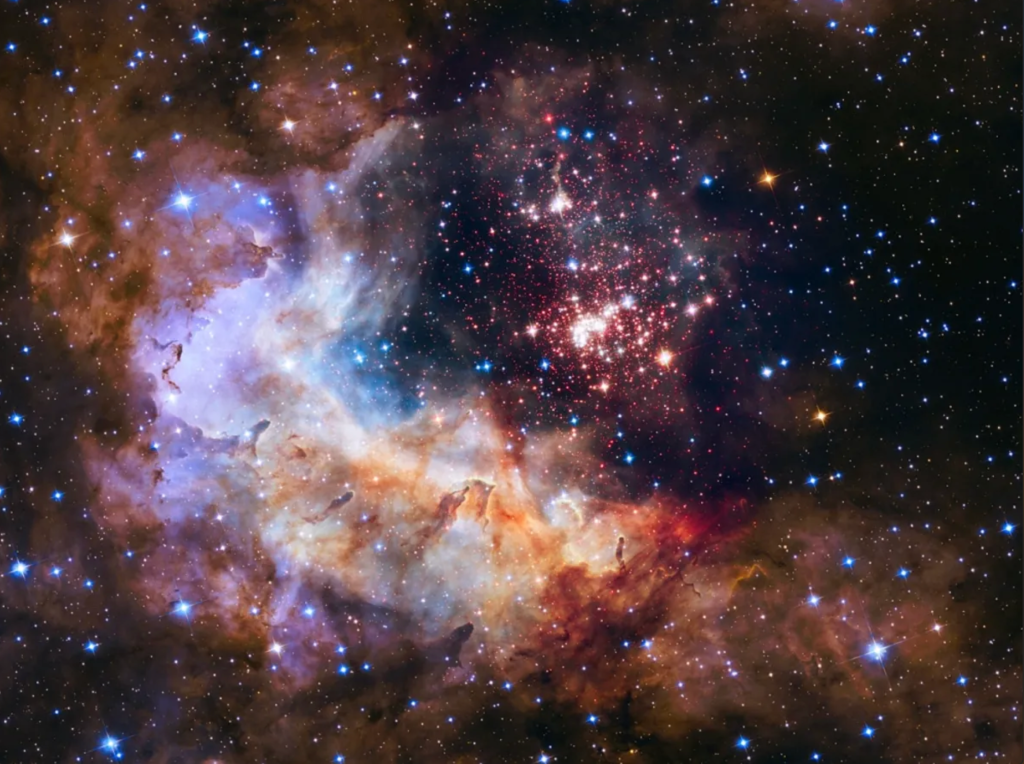
In an ambitious effort to deepen our understanding of the cosmos, astronomers have undertaken a detailed multiwavelength study of NGC 2316, a star cluster nestled within the Milky Way. This research endeavor has provided unprecedented insights into the cluster’s physical attributes and its significant role within the galactic framework. NGC 2316, characterized by its elongated shape and relatively modest size, lies approximately 1.3 kiloparsecs from Earth. The cluster’s minimal reddening and the discovery of two embedded massive stars illuminate the ongoing saga of star formation, revealing a complex interplay between the cluster’s existing stellar population and its nascent stars.
The analysis of NGC 2316 extends beyond the mere cataloging of its stars. It delves into the dynamics of the surrounding region, where a cold gas and dust lane emerges as a cradle of star formation. This lane, stretching westward from the cluster, delineates a clear gradient in stellar birth, favoring the emergence of low-mass stars at its western extremity while nurturing more massive stars closer to the cluster’s heart. Such observations underscore the influence of stellar feedback mechanisms, where the energy and material expelled by stars sculpt the surrounding medium, catalyzing the birth of new stars under varying conditions.
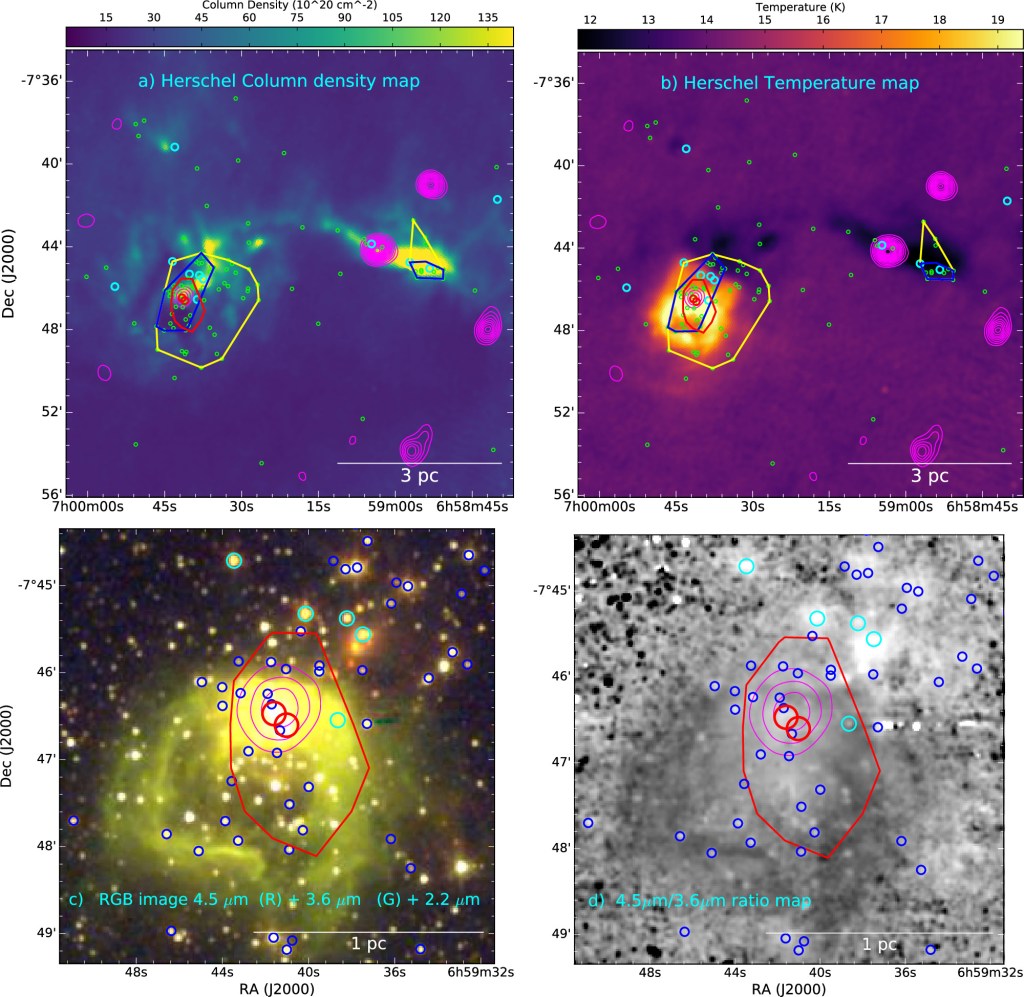
Moreover, the study brings to light the presence of an elongated molecular cloud adorned with filamentary structures, suggesting a hub-filamentary system (HFS) with NGC 2316 acting as the gravitational anchor. This system illustrates a broader galactic narrative, where filamentary structures funnel material toward dense hubs, sparking star formation. The intricate dance of matter and energy observed in this region offers a microcosmic view of the processes that likely play out across the universe, contributing to the complex mosaic of cosmic evolution.
The findings from NGC 2316 challenge and refine our understanding of how stars form in the Milky Way. By identifying the sequential nature of star formation within this HFS, researchers highlight the pivotal role of gravity and material flow in shaping stellar communities. The discovery of young stellar objects (YSOs) of varying ages and masses within this region further emphasizes the diversity and complexity of star formation, driven by a combination of local conditions and broader galactic dynamics.
This groundbreaking research into NGC 2316 not only enriches our knowledge of the star formation process but also underscores the importance of multiwavelength observations in piecing together the vast puzzle of the universe. The cluster’s role as a gravitational well, pulling in material and fostering new generations of stars, mirrors the dynamic processes that underpin galactic evolution. As we continue to unveil the secrets of NGC 2316 and similar regions, we edge closer to a more comprehensive understanding of the cosmos, its origins, and its myriad pathways of development.
Source: Sharma, Saurabh, et al. “Cluster Formation in a Filamentary Cloud: The Case of the Stellar Cluster NGC 2316.” The Astronomical Journal, vol. 167, no. 3, 2024, p. 106, dx.doi.org/10.3847/15383881/ad19cd, https://doi.org/10.3847/15383881/ad19cd.
Featured Image: N159, ESA/Hubble & NASA; CC BY 4.0


 ad*astra daily