
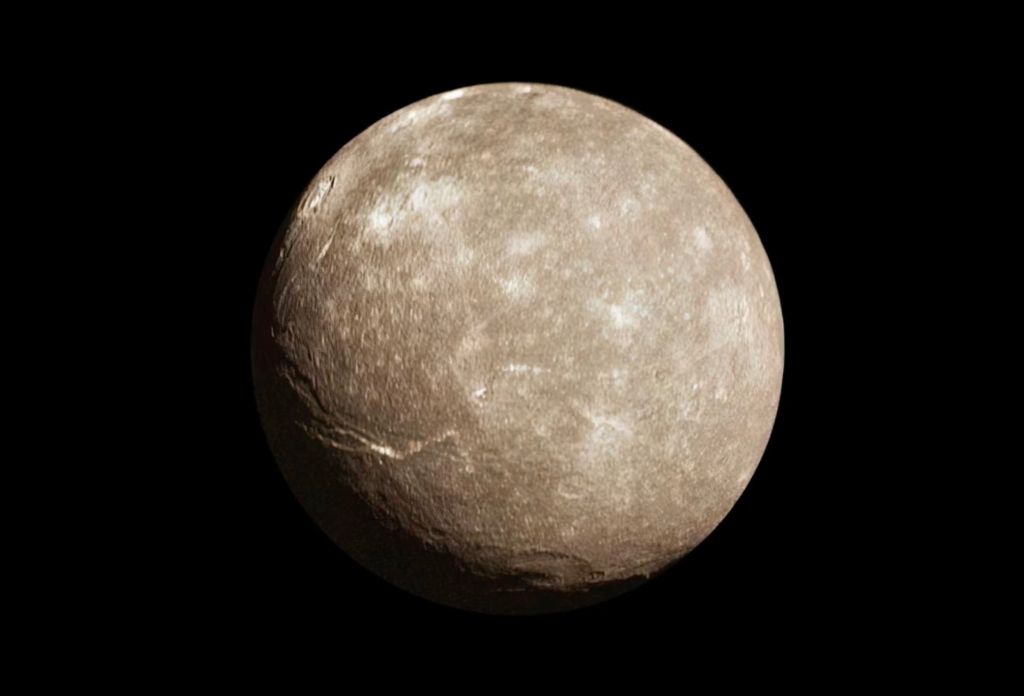
In a recent study, scientists have unveiled new aspects of Titania, the largest of Uranus’s moons, revealing a surface intricately marked by both craters and significant tectonic activities. Utilizing newly enhanced Voyager 2 images, researchers have pieced together a detailed map of Titania, challenging previous notions about its crater population.
Titania stands out in the Uranian system, positioned between the heavily cratered Umbriel and the tectonically active Miranda, as a celestial body that marries the features of both worlds. Despite its heavily cratered landscape, Titania has long puzzled scientists with its relative scarcity of large craters exceeding 30 kilometers in diameter.
The recent advancements in image processing have allowed for a reduction in motion blur effects on Voyager’s pictures, shedding light on Titania’s true face. The reprocessed images have uncovered a complex network of fractures, potential multi-ring impact structures, and previously unseen catenae, suggesting a dynamic geological past.
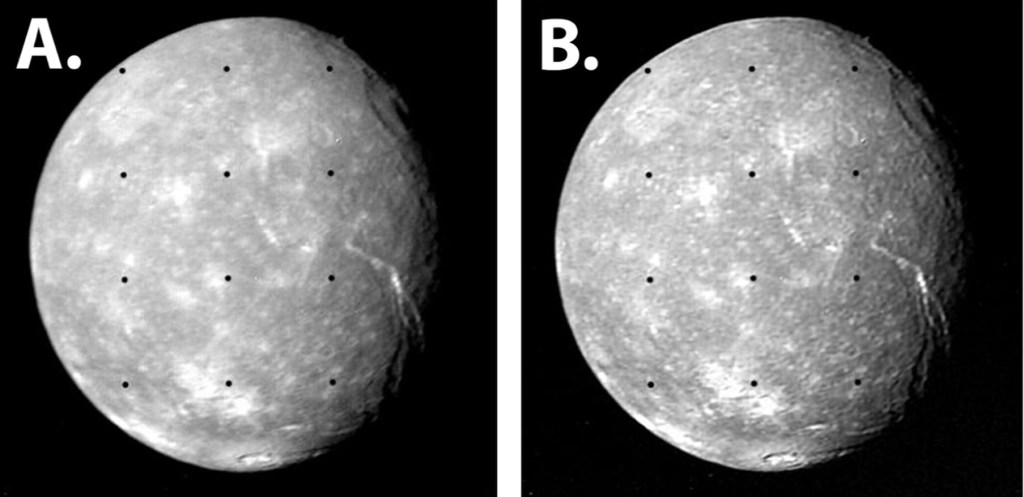
This research proposes that the lack of large craters on Titania can be attributed to a combination of factors, including viscous relaxation, tectonic resurfacing, and the influence of planetocentric debris, rather than solely cryovolcanic activities as previously thought. The discovery of a vast network of fractures emanating from the Messina Chasmata, a significant fault zone, further supports this hypothesis.
The findings hold implications for our understanding of the Uranian system and icy satellite evolution at large. They hint at a geologically vibrant history for Titania, involving periods of heavy cratering, tectonic reshaping, and possibly cryovolcanic resurfacing. These insights are critical for the planning of future missions to Uranus, prioritized as a flagship destination by the Planetary Science and Astrobiology Decadal Survey for 2023–2032.
Moreover, the research raises intriguing questions about the formation of the Uranian satellites, the early impactor flux in the outer solar system, and the long-term dynamics of the Uranian rings. There’s also speculation on the potential existence of subsurface oceans on Uranus’s moons, with Titania possibly harboring an ocean to this day.
As the scientific community prepares for future explorations, the reevaluation of Voyager 2 data marks a significant step forward in demystifying the history and evolution of not only Titania but the broader mysteries enveloping the Uranian system.
Source: Nathan, Erica, et al. “Cratering and Tectonic History of the Largest Uranian Satellite, Titania: New Insights Enabled by Image Reprocessing.” The Planetary Science Journal, vol. 5, no. 1, 2024, p. 6, dx.doi.org/10.3847/PSJ/ad04d6, https://doi.org/10.3847/PSJ/ad04d6.
Featured Image: NASA/JPL
 ad*astra daily