
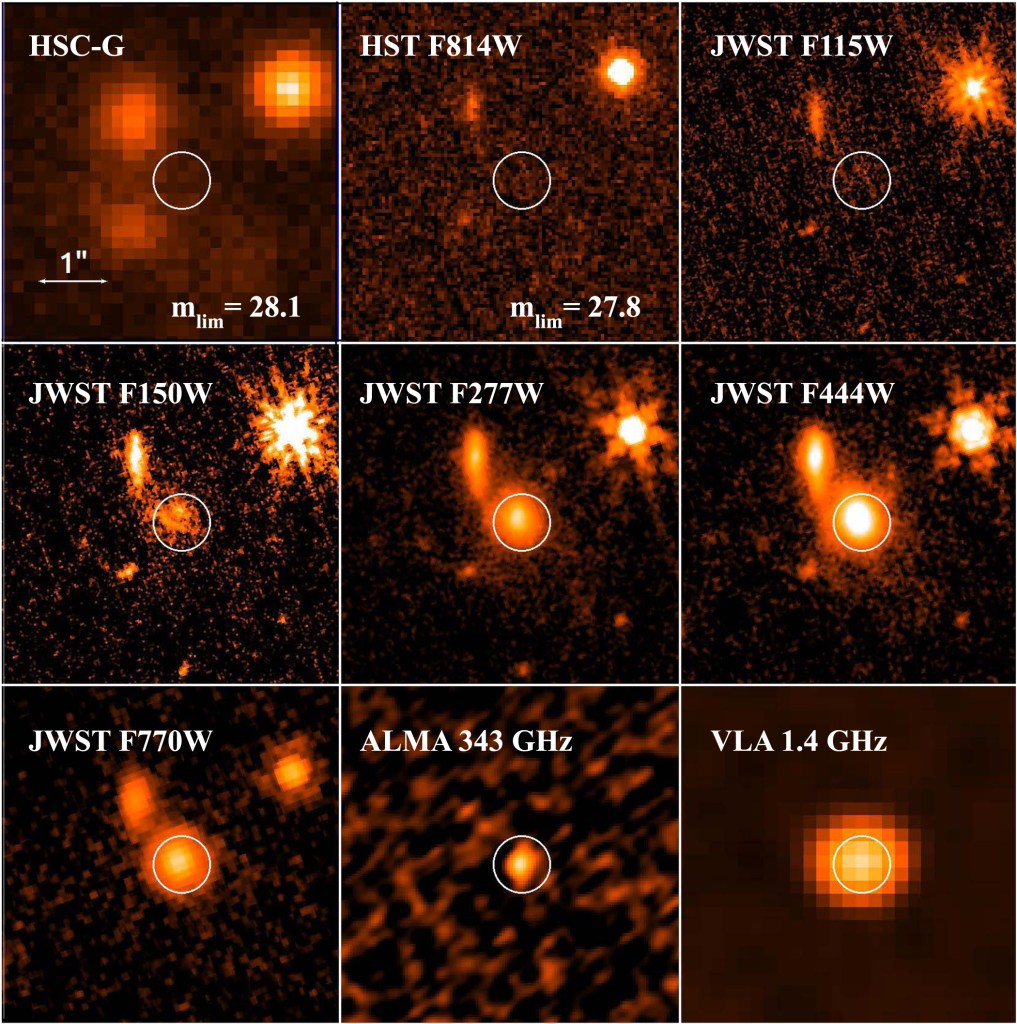
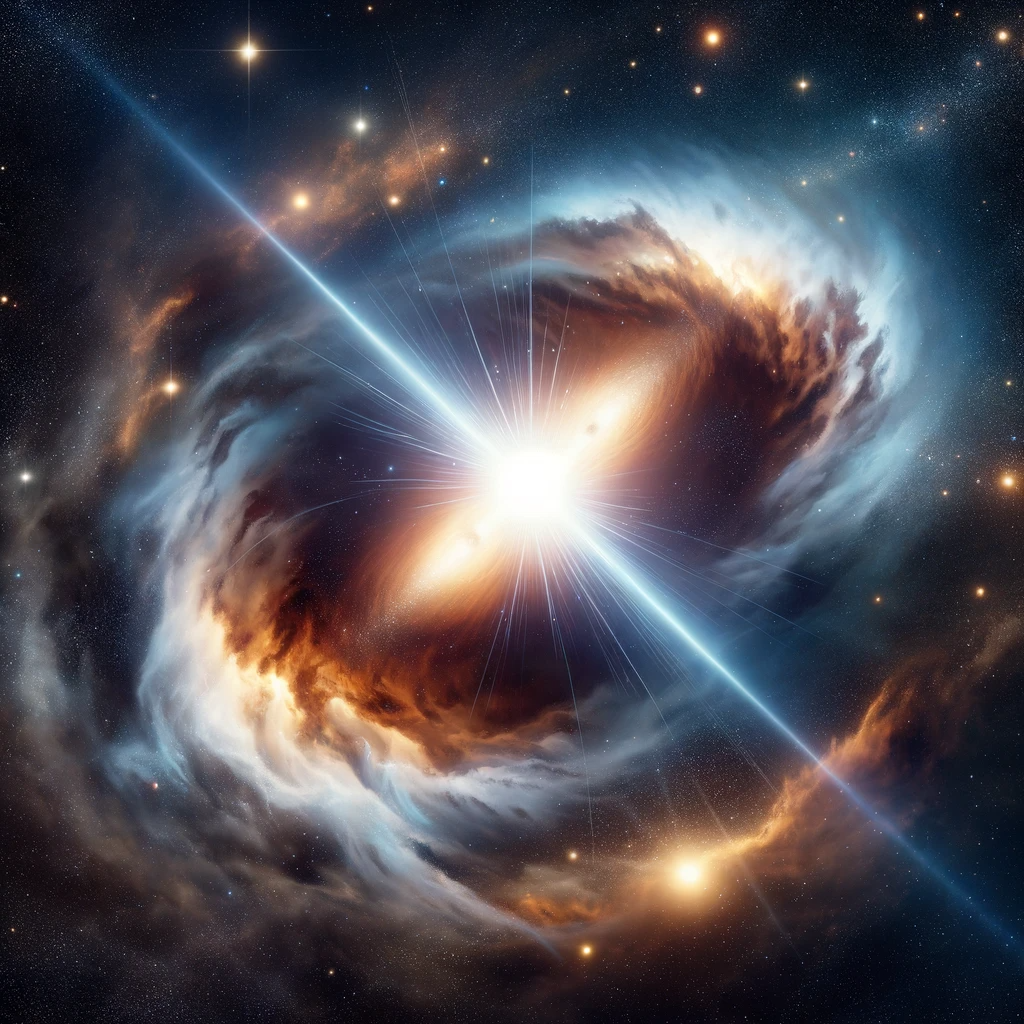
In a new study, astronomers have unveiled the discovery of the most distant heavily obscured, radio-loud active galactic nucleus (AGN) candidate to date, identified in the COSMOS-Web field using a combination of James Webb Space Telescope (JWST) NIRCam/MIRI imaging, mid-infrared, submillimeter, and radio data. This remarkable find, a growing supermassive black hole at a photo-z of 7.7, showcases significant spectral steepening across its radio emissions without any visible contribution to UV/optical/near-infrared data, suggesting extreme obscuration.
This discovery is pivotal as it challenges current understandings of the formation and growth of massive black holes early in the universe’s history. The majority of previously observed AGNs at such high redshifts were unobscured, making this finding crucial for studying the properties of their host galaxies, which are more difficult to discern in unobscured AGNs.
The host galaxy of this AGN is estimated to be extremely massive, indicating the presence of a powerful, growing supermassive black hole. This discovery aligns with theories suggesting a significant portion of AGN at this epoch are heavily obscured, a notion supported by both theoretical models and observations. The identification of such AGNs has been challenging due to their heavy obscuration and the limitations of current observing facilities in probing the necessary wavelengths.
The identification of COSW-106725, along with a previously discovered obscured AGN, suggests that the space density of luminous, radio-loud AGNs at these epochs may be significantly underestimated. This discovery, facilitated by the unprecedented resolution and sensitivity of the JWST and supplemented by deep ground-based observations and ancillary space-based data, marks a significant step forward in understanding the early universe’s black hole formation and growth.
This finding opens up new pathways for research, suggesting that heavily obscured AGNs play a crucial role in the early stages of the universe and challenging astronomers to rethink the mechanisms behind black hole growth and the evolution of their host galaxies during the epoch of reionization.
Source: Lambrides, Erini, et al. “Uncovering a Massive Z ∼ 7.7 Galaxy Hosting a Heavily Obscured Radioloud Active Galactic Nucleus Candidate in COSMOSWeb.” The Astrophysical Journal Letters, vol. 961, no. 1, 2024, p. L25, dx.doi.org/10.3847/20418213/ad11ee, https://doi.org/10.3847/20418213/ad11ee.
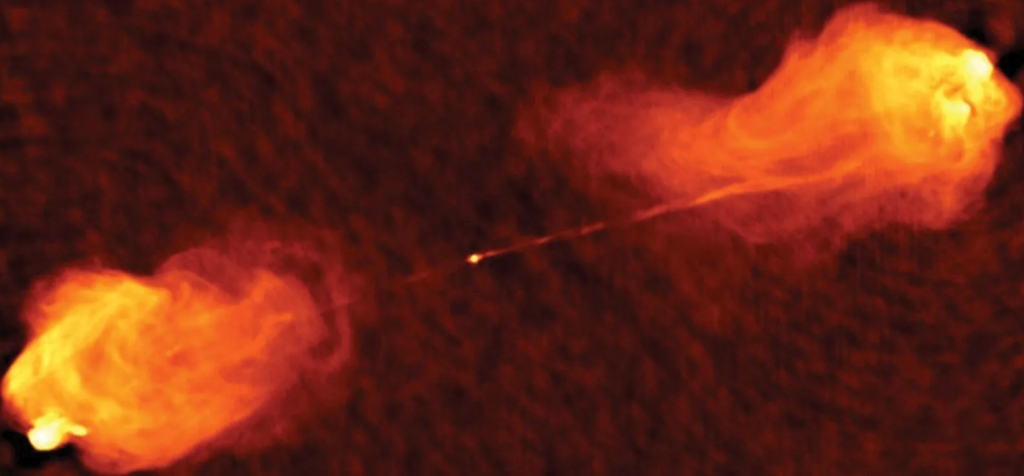
Featured Image: Cygnus A – NRAO/AUI

 ad*astra daily