
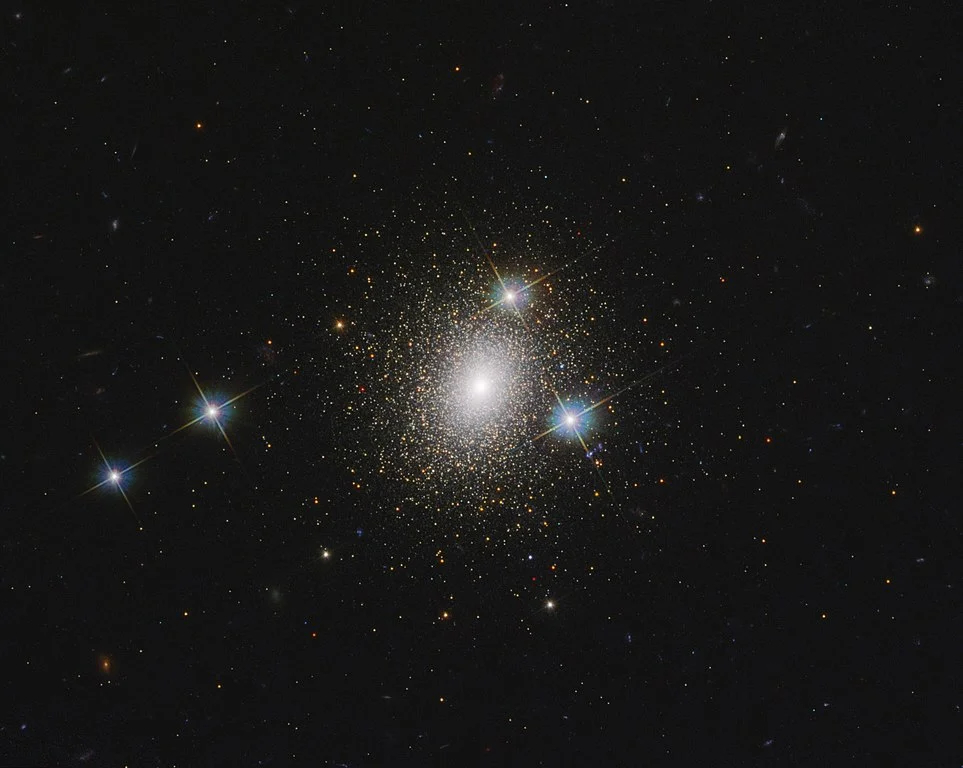
In a groundbreaking advancement in the field of astronomy, scientists have unveiled new catalogs of potential globular clusters (GCs) in 17 nearby spiral galaxies, as part of the extensive PHANGS Hubble Space Telescope (HST) Treasury Survey. These galaxies were meticulously observed across five broadband filters, ranging from the near-ultraviolet to the I band, paving the way for a comprehensive catalog of stellar clusters of various ages. The process involved selecting extended sources through multiple concentration index measurements, followed by a detailed morphological classification to identify those that are centrally concentrated, symmetric, asymmetric, or potentially contaminants. This meticulous classification was aided by visual examination of the V-band images and reinforced by a machine-learning algorithm for larger sample sizes, allowing for the identification of candidates down to fainter limits.

Globular clusters are dense, spherical collections of stars that orbit the cores of galaxies. They are among the oldest visible objects in the universe, often exceeding 10 billion years in age, which makes them nearly as old as the universe itself. These ancient stellar assemblies provide critical insights into the early stages of galaxy formation and evolution, as well as the nature of dark matter. Comprising hundreds of thousands to millions of stars, globular clusters are distinguished by their tight gravitational binds, allowing them to survive the gravitational pull of their host galaxies. Their study helps astronomers understand the processes of stellar evolution and the chemical enrichment of the interstellar medium over cosmic time.
The team conducting the study applied stringent color criteria to select initial GC candidates, followed by a thorough visual inspection to weed out contaminants, such as reddened young clusters, misclassified background galaxies, and chance superpositions. This rigorous selection process revealed that a significant portion of the color-selected candidates are likely genuine GCs, highlighting the effectiveness of the combined human and machine-learning approach in identifying these ancient stellar systems.
Remarkably, the study found atypical luminosity in two of the galaxies, NGC 628 and NGC 3627, where the distribution of GC candidates extends significantly fainter than the expected turnover. This suggests the presence of faint GCs with extended spatial distributions, potentially residing in the disk rather than the bulge/halo of these galaxies. These findings open new avenues for understanding the formation and survival of lower-mass, intermediate-age clusters in spiral galaxies.
Globular clusters are crucial for understanding a myriad of astrophysical phenomena, from stellar and chemical evolution to the formation and assembly histories of galaxies. This study, leveraging the unparalleled imaging capabilities of the HST, marks a significant leap forward in our understanding of GC systems in spiral galaxies, traditionally a challenging area due to the complex structures and ongoing star formation in these galaxies. The comprehensive catalogs produced by the PHANGS-HST survey provide a resource for future studies, promising deeper insights into the ancient populations of spiral galaxies and their contributions to our understanding of the universe.
Source: Floyd, Matthew, et al. “PHANGS Hubble Space Telescope Treasury Survey: Globular Cluster Systems in 17 Nearby Spiral Galaxies.” The Astronomical Journal, vol. 167, no. 3, 2024, p. 95, dx.doi.org/10.3847/15383881/ad1889, https://doi.org/10.3847/15383881/ad1889.
Featured Image: Image: Judy Schmidt (CC BY 2.0)

 ad*astra daily