
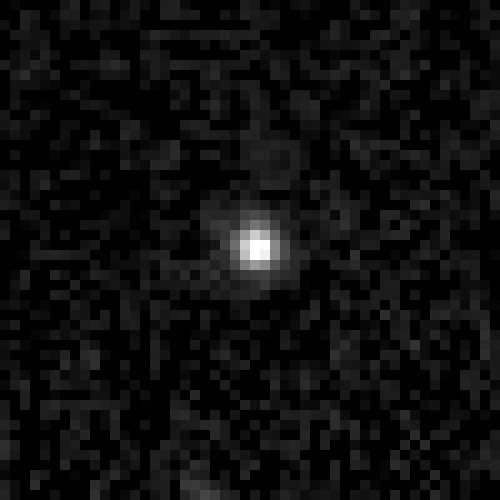
In a new study, scientists have deepened our understanding of the enigmatic rings surrounding Chariklo, the largest known Centaur—a small body orbiting between Jupiter and Neptune. With a diameter of approximately 250 km, Chariklo was discovered to possess two thin rings, marking the first discovery of its kind outside the giant planets. These findings, initially revealed through a stellar occultation in 2013, have puzzled astronomers due to their unique formation and evolutionary mechanisms.

Researchers have now explored the possibility of a single shepherd satellite being responsible for confining Chariklo’s rings. Utilizing modified N-body code developed for Saturn’s rings, the team has delved into the dynamics of this small celestial body’s system. Modified N-body code refers to a type of computational algorithm used in astrophysics and celestial mechanics to simulate the dynamical evolution of a system of particles under the influence of gravitational forces. “N-body” refers to the problem of predicting the individual motions of a group of celestial objects interacting with each other gravitationally.
The study suggests that a satellite with a mass of a few times 10^13 kg, in orbital resonance with the rings, could maintain their stability. This satellite’s influence also plays a critical role in the reaccretion process, where ring material outside the classical Roche limit could potentially form moonlets.
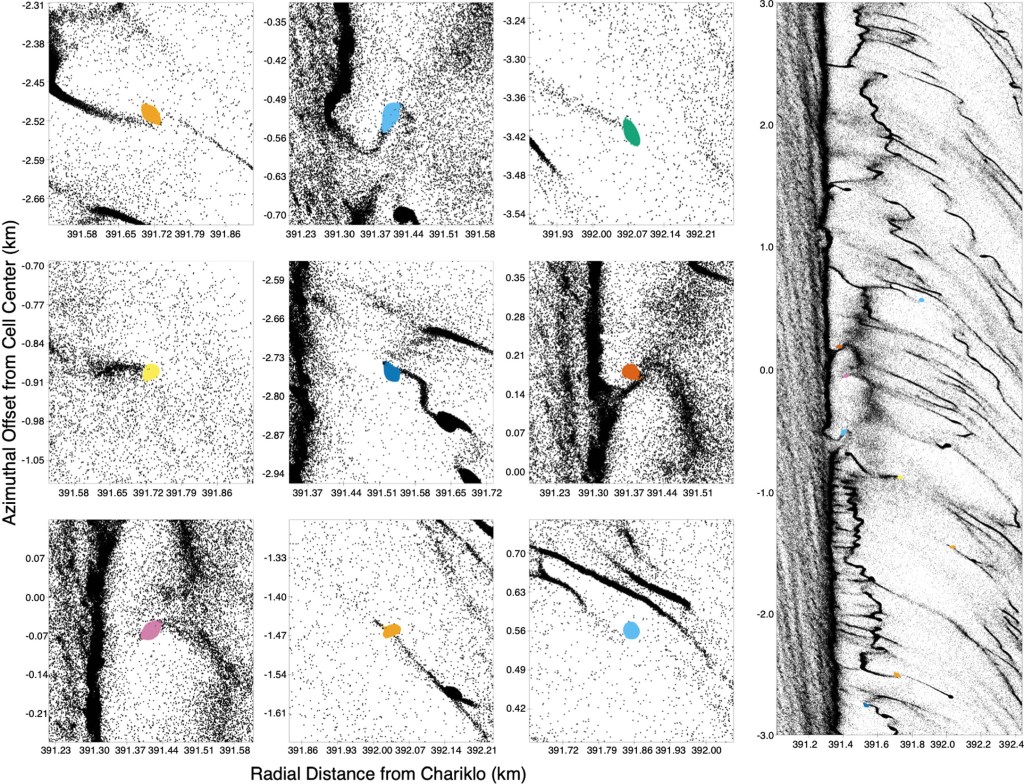
This image is from a simulation showing particles forming moonlets on the 27th orbit. Black dots represent particles. The right side shows part of the simulation with less visible patterns due to the formation of moonlets. On the left, there are close-ups of some of the moonlets, with over 40 identified. Their locations are marked in color on the right.
The investigation into Chariklo’s rings also involved analyses of additional stellar occultations from 2014 to 2020. These further confirmed the rings’ characteristics and introduced new findings, such as a W-shaped structure within one of the rings and their placement near a significant orbital resonance with Chariklo itself.
Comparisons with ring systems of giant planets highlight distinct differences and similarities, suggesting diverse formation mechanisms. Theories range from accretion of remnants from a disrupted satellite, tidal disruptions, to volatile outgassing, challenging previously held notions about the lifetimes and stability of such rings given the chaotic nature of Centaur orbits.
This research advances our understanding of Chariklo’s rings, opening up new avenues for studying ring systems around other small bodies in our solar system. The potential existence of shepherd satellites and the mechanisms behind ring confinement and moonlet formation offer valuable insights into the complex dynamics of celestial bodies beyond the realm of the giant planets.
Source: Sickafoose, Amanda A, and Mark C Lewis. “Numerical Simulations of (101) Chariklo’s Rings with a Resonant Perturber.” The Planetary Science Journal, vol. 5, no. 2, 2024, p. 32, dx.doi.org/10.3847/PSJ/ad151c, https://doi.org/10.3847/PSJ/ad151c.
Featured Image: NASA/Hubble Space Telescope/Bruno Sicardy


 ad*astra daily