
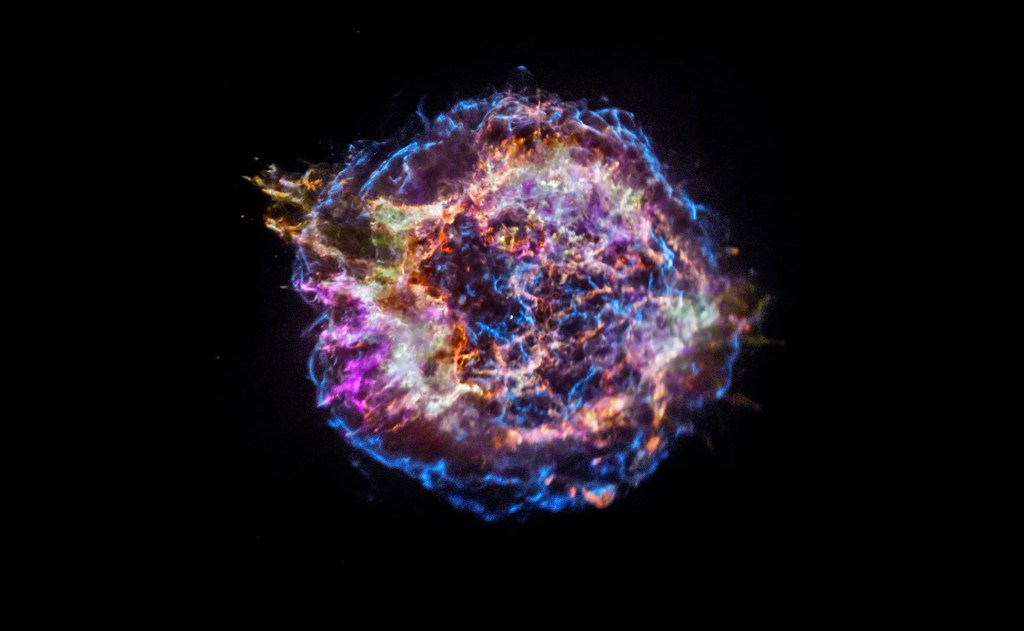
In a recent study, the historic supernova remnant (SNR) Cassiopeia A (Cas A) has been observed with the LHAASO KM2A detector, challenging the long-standing belief that such remnants are the primary sources of cosmic rays (CRs) reaching PeV (Petaelectronvolt) energies in our galaxy. For many years, scientists believed that supernova remnants (SNRs) were the main source of cosmic rays in our galaxy, especially for those with very high energy, up to a certain point called the “knee” in the cosmic ray energy chart, which is at energy levels around 3-4 Petaelectronvolts (PeV).
A Petaelectronvolt (PeV) is a unit of energy used in particle physics. It’s a very large unit of energy, especially when talking about particles like protons and electrons. One Petaelectronvolt equals 1 quadrillion electronvolts (1 PeV = 1,000,000,000,000,000 eV or 10^15 eV).
They mainly thought this because of a widely accepted theory called diffusive shock acceleration (DSA), which explains how cosmic rays get their energy from the shock waves produced in these supernova remnants. However, the recent observations of Cas A, one of the youngest and brightest SNRs in our galaxy, suggest that these remnants might not be as efficient at accelerating CRs to PeV energies as previously thought.
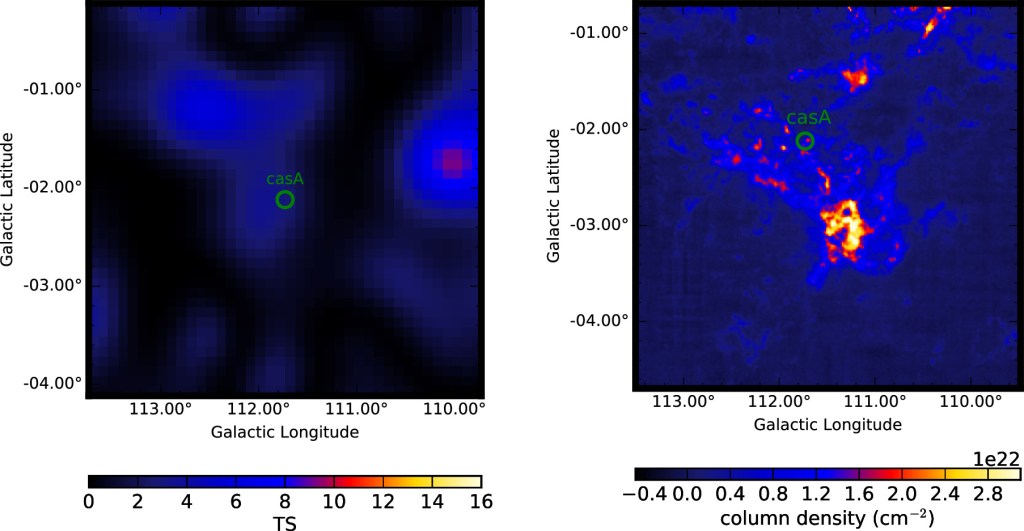
The LHAASO KM2A’s unprecedented sensitivity in the ultrahigh-energy (UHE) band has allowed researchers to set stringent limits on the energy budget of UHE protons and nuclei accelerated by Cas A. These findings put into question the prevailing paradigm of SNRs like Cas A being major suppliers of PeV CRs.
The paper discusses the theoretical challenges in accelerating protons to ultrahigh energies and reviews the physical properties of Cas A, including the gas distribution in its vicinity. It also describes the methodology of extracting flux upper limits from the LHAASO KM2A data. The results, which have significant astrophysical implications, suggest a need to reassess the role of SNRs in contributing to the CR flux up to the “knee.”
The paper explores various scenarios explaining the observations of steep γ-ray spectra from young SNRs. While some scenarios suggest that the steepness results from a combination of a hard power-law spectrum and an early exponential cutoff, others propose that the steep spectra extend up to 1 PeV, questioning the effectiveness of SNRs as PeVatron, sources capable of accelerating particles to PeV energies.
This research utilizing LHAASO KM2A data provides critical insights into the CR acceleration capabilities of SNRs, specifically Cas A, challenging the conventional understanding and opening doors for new theoretical and observational inquiries in the field of high-energy astrophysics.
Source: Cao, Zhen, et al. “Does or Did the Supernova Remnant Cassiopeia a Operate as a PeVatron?” The Astrophysical Journal Letters, vol. 61, no. 2, 2024, p. L43, dx.doi.org/10.3847/20418213/ad1d62, https://doi.org/10.3847/20418213/ad1d62.
Featured Image: NASA/CXC/SAO
 ad*astra daily