
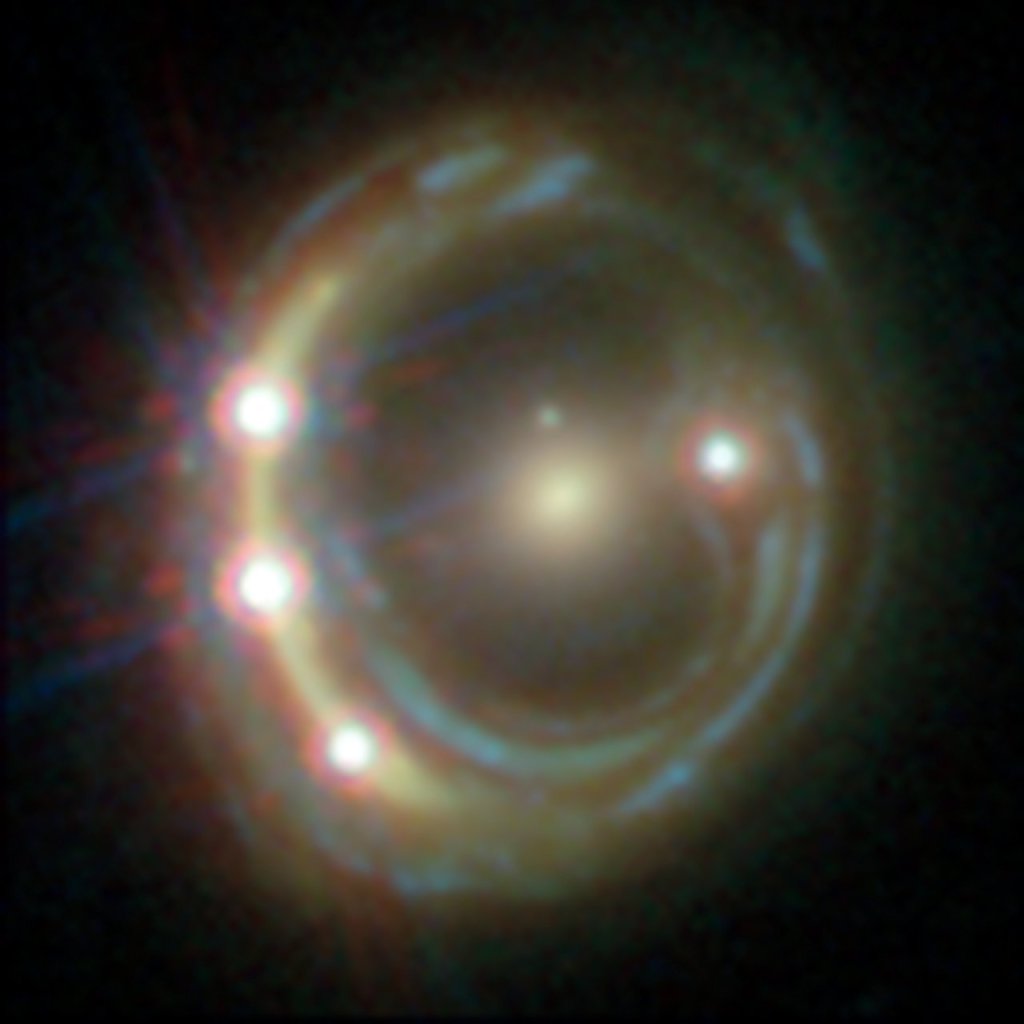
A groundbreaking study examining the strong gravitational lens, B1422+231, has used the Atacama Large Millimeter Array (ALMA) to explore the potential role of primordial black holes (PBHs) as a constituent of dark matter. This research, centered around the flux density ratio anomaly observed in this quadruply imaged system, presents the first measurements in the millimeter-wave band.
Flux density ratio, in the context of astronomical observations, especially those involving gravitational lensing, refers to the ratio of the observed brightness (or flux density) of different images of the same astronomical object. When a distant object, like a quasar, is gravitationally lensed by a massive object like a galaxy or a galaxy cluster lying between the distant object and the observer, multiple images of the same object can be formed.
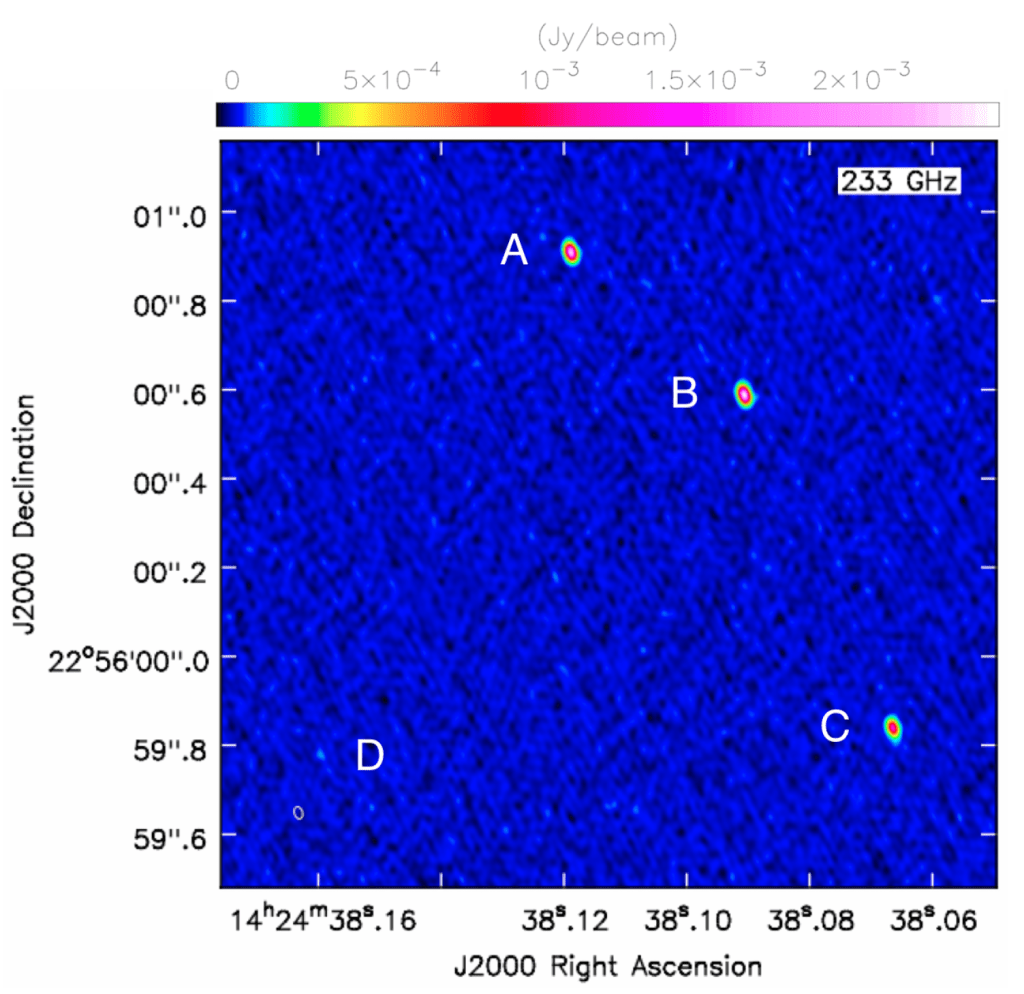
The study focused on the quasar B1422+231, whose flux density at 233 GHz, dominated by synchrotron emission, suggests a source size under 66.9 parsecs. Remarkably, the observed flux density ratios at this frequency resemble those recorded in other wavebands, challenging the predictions of simple smooth mass models of the lens galaxy.
The researchers conducted ray tracing simulations to evaluate the possibility that this anomaly arises from microlensing by PBHs, considering scenarios where 10% and 50% of dark matter comprises PBHs, ranging from 10 to 10^3 solar masses. These simulations align with ALMA observations, indicating that PBHs as dark matter components could indeed be responsible for the observed flux density ratio anomalies.
This study not only provides a compelling explanation for the peculiarities observed in B1422+231 but also opens up new possibilities for understanding the elusive nature of dark matter. The suggestion that a significant fraction of dark matter might consist of PBHs, particularly in the range of 10–10^3 solar masses, adds a new dimension to our understanding of the universe’s fundamental structure.
Dark matter is a form of matter that does not emit, absorb, or reflect light, making it invisible and detectable only through its gravitational effects. Despite being invisible, dark matter is thought to constitute about 85% of the total matter in the universe and about 27% of the universe’s total mass-energy content. The existence of dark matter is inferred from various astronomical observations.
The implications of these findings are profound, offering potential insights into the formation of intermediate-mass black holes and shedding light on the large-scale structure and evolution of the cosmos. As we continue to unravel these cosmic mysteries, the role of PBHs in the dark matter puzzle remains a tantalizing and promising field of inquiry.
Source: Wen, Di, and Kemball, Athol J. “Testing Primordial Black Hole Dark Matter with Atacama Large Millimeter Array Observations of the Gravitational Lens B1422+231.” Universe, vol. 10, no. 1, 2024, https://doi.org/10.3390/universe10010037.
Featured Image: ESA/Hubble, NASA, Suyu et al.

 ad*astra daily