
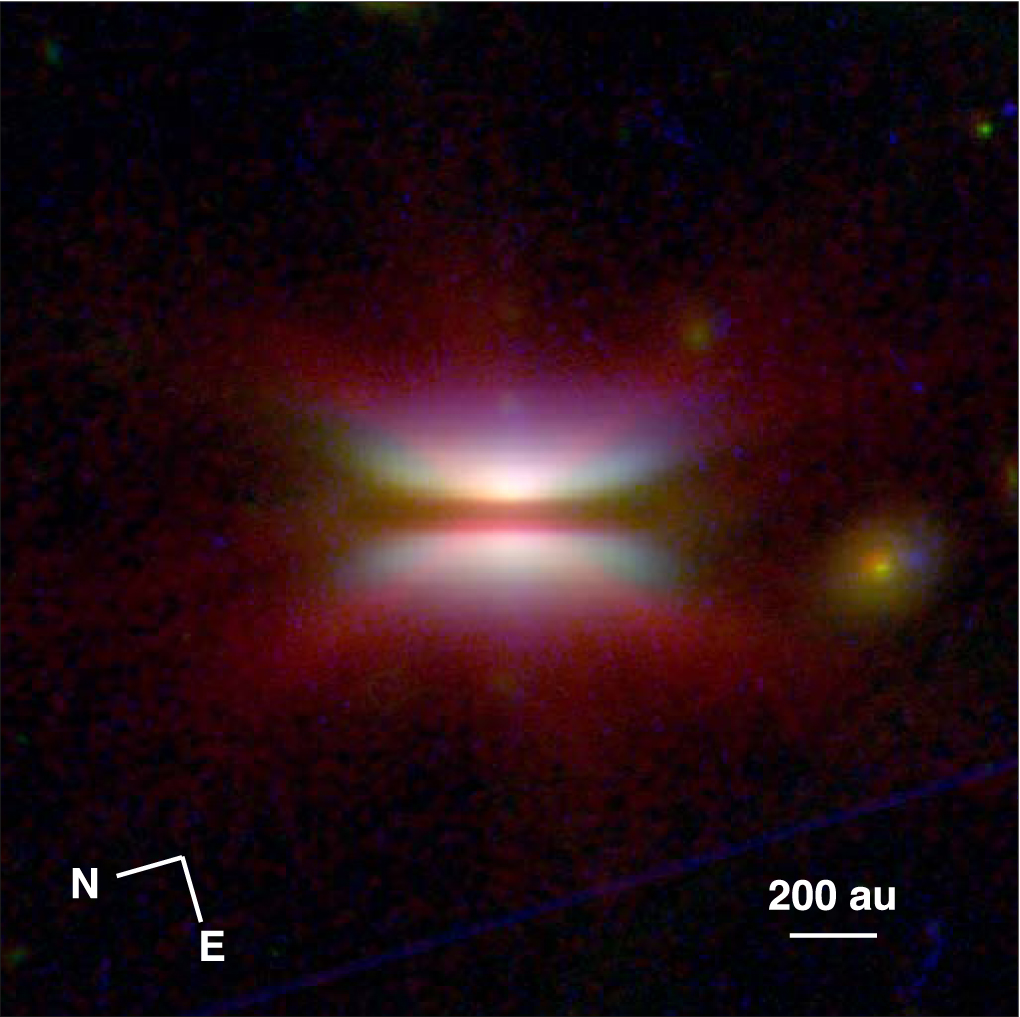
In an exciting development, the James Webb Space Telescope (JWST) has provided groundbreaking 2–21 μm images of a 1000 au radius protoplanetary disk surrounding a 0.4 M⊙ young star in the Taurus region. These observations are pivotal as they mark the longest wavelengths at which a protoplanetary disk has been spatially resolved in scattered light, offering unprecedented insights into the disk’s geometry and dust properties.
A protoplanetary disk is a rotating disk of dense gas and dust surrounding a newly formed star, known as a protostar. These disks are the birthplaces of planets. The material in the disk originates from the molecular cloud that collapses to form the star and subsequently flattens into a disk due to the conservation of angular momentum.
In the disk, particles of dust collide and stick together, gradually growing from microscopic sizes to larger bodies—first pebbles, then rocks, and eventually planetesimals, which are the building blocks of planets. Through processes like accretion and gravitational interactions, these planetesimals can further combine to form planets. Protoplanetary disks are also the regions where the chemical ingredients essential for life are mixed, heated, and transformed through various processes.
The recent study, complemented by Hubble Space Telescope optical images and data from the Atacama Large Millimeter/submillimeter Array (ALMA), has revealed that the disk’s morphology remains remarkably consistent across a wide range of wavelengths, indicating that the dust in the disk’s surface layers exhibits almost gray opacity. This finding is essential for understanding the interaction of light with dust particles and provides vital clues about the size and composition of the dust grains.
Models applied to these observations suggest the presence of grains up to ≳10 μm fully integrated with the gas, while larger grains, ≳100 μm, are predominantly settled toward the disk’s midplane. This settling is crucial for understanding the early stages of planet formation and the evolution of the disk.
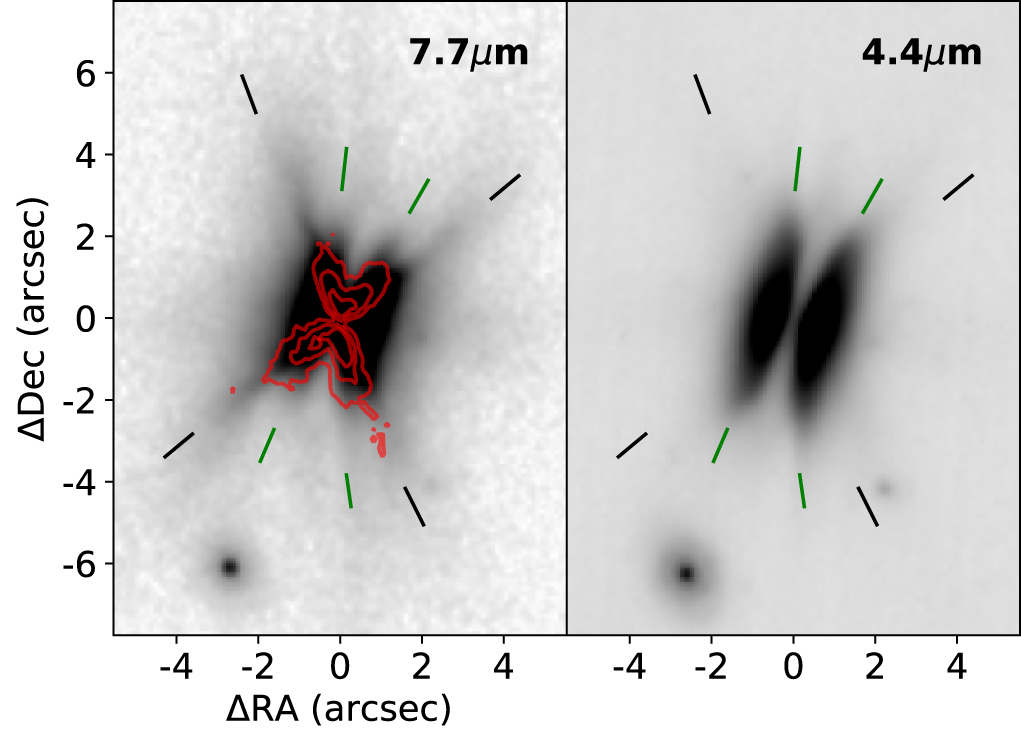
Moreover, the JWST images have unveiled an intriguing X-shaped feature above the disk’s warm molecular layer, traced by CO line emission, which might be linked to a disk wind carrying small dust grains. This phenomenon aligns with the highest elevations detectable in visible wavelength scattered light and presents an unusual kinematic signature in CO emissions, offering new avenues for understanding disk dynamics and evolution.
This study of Tau 042021, one of the largest disks in Taurus, not only sheds light on the dust settling processes but also sets a benchmark for future observations of edge-on disks (EODs). With the advent of JWST and its high-resolution imaging capabilities, astronomers are now better equipped to probe the intricate processes of dust grain growth and settling, providing critical insights into the initial stages of planet formation and disk evolution. The study’s findings are expected to significantly contribute to refining our models of disk dynamics and the formation of planetary systems.
Source: Duchêne, Gaspard, et al. “JWST Imaging of Edgeon Protoplanetary Disks. I. Fully Vertically Mixed 10 Μm Grains in the Outer Regions of a 1000 Au Disk.” The Astronomical Journal, vol. 167, no. 2, 2024, p. 77, dx.doi.org/10.3847/15383881/acf9a7, https://doi.org/10.3847/15383881/acf9a7.
Featured Image: NASA / JWST / Duchêne et al


 ad*astra daily