
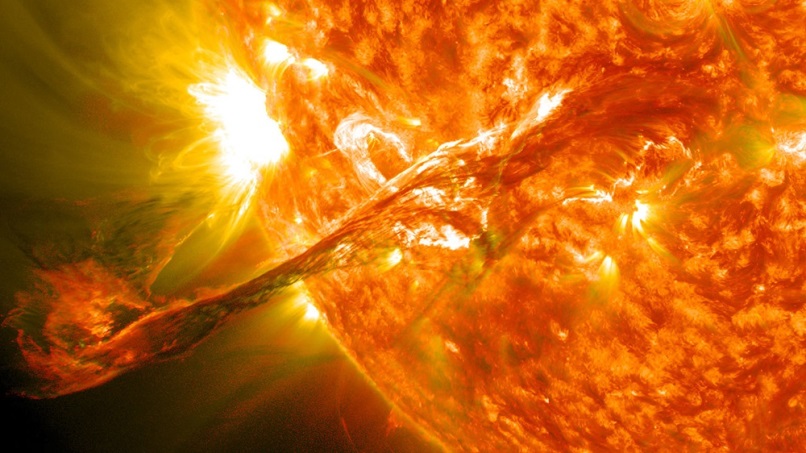
A recent study conducted using the Chinese Hα Solar Explorer (CHASE) has made significant strides in decoding the complex three-dimensional movements of solar filaments, a key factor in predicting space weather phenomena. These solar filaments, also known as prominences when observed on the edge of the Sun, eject massive amounts of plasma and high-energy particles into space, impacting the Earth’s space environment.
A solar filament is a large, elongated structure in the Sun’s atmosphere, appearing as a dark line against the brighter solar surface when viewed in certain wavelengths of light. Filaments are essentially cooler, denser gases suspended above the Sun’s surface (or photosphere) by magnetic fields. They contain plasma, a collection of charged particles that follow the magnetic field lines, forming a kind of structure that’s like a suspended bridge in the Sun’s corona (the outermost layer of the solar atmosphere).
The CHASE, a groundbreaking observatory, has provided full-disk spectral and imaging data, enabling scientists to construct the three-dimensional kinematics of both an off-limb prominence and an on-disk filament. Observations reveal that both structures initially undergo rapid, semicircle-shaped expansion. The prominence continues its outward trajectory, increasing in velocity before escaping, while part of it swirls back to the Sun’s surface. Conversely, the filament exhibits a failed eruption, with its internal plasma falling back to the Sun in a counterclockwise motion, without triggering a coronal mass ejection.
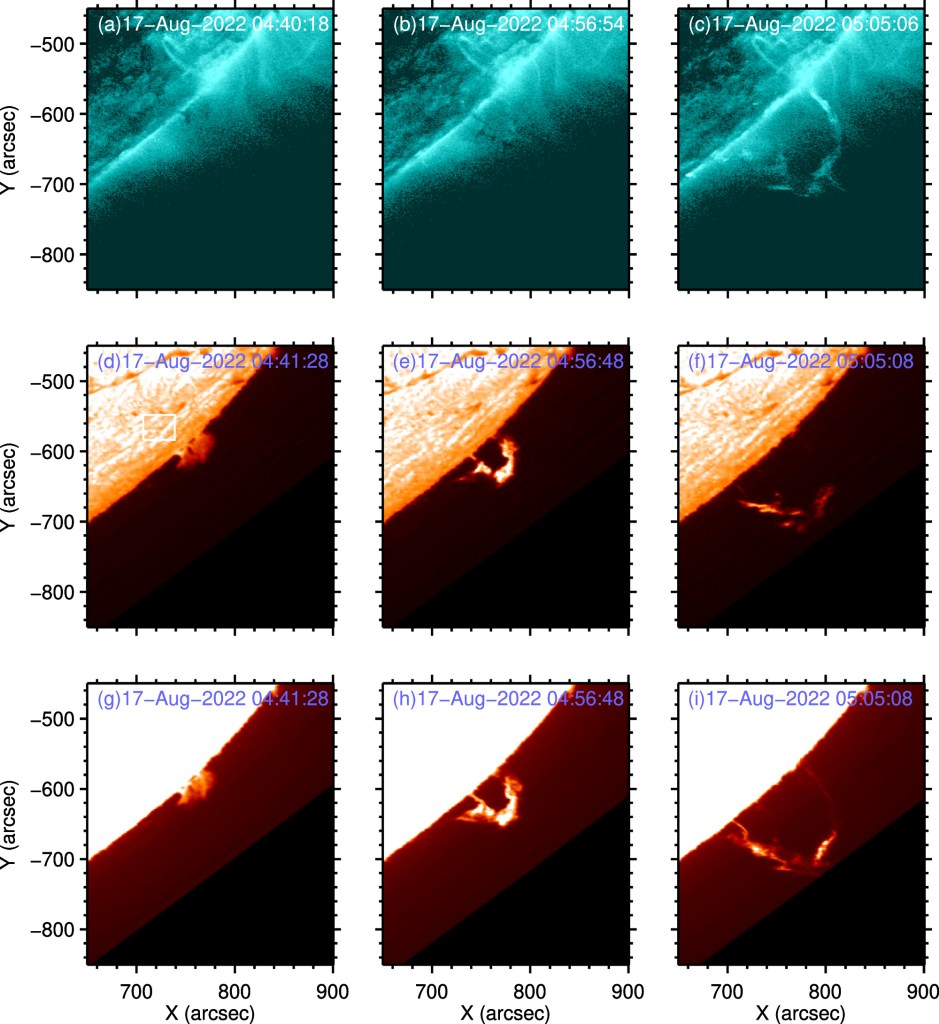
A notable discovery during these eruptions is the material splitting within both the prominence and the filament, a phenomenon characterized by bimodal Hα spectral profiles. For the prominence, this splitting starts at the top and gradually pervades the entire structure, displaying both fast blueshift and slow redshift components. The filament’s splitting, on the other hand, appears more fragmented.
Understanding the dynamics of such solar phenomena is crucial, given that eruptive filaments evolving into coronal mass ejections can lead to geomagnetic storms, posing threats to advanced technological systems on Earth. Traditional methods of tracking these eruptions involve observing the plane-of-sky apex of ascending filaments and fitting their trajectory with specific mathematical functions. However, these methods fall short in measuring the line-of-sight kinematic parameters.
The CHASE’s comprehensive observations, including the detection of Doppler shifts through spectroscopic data, offer a more complete picture by providing insights into the three-dimensional kinematics of solar filament eruptions. This breakthrough is pivotal for comprehending the physical mechanisms behind these eruptions and enhancing the accuracy of space-weather forecasts, marking a significant leap in our ability to predict and mitigate the impacts of solar activity on terrestrial systems.
Source: Qiu, Ye, et al. “Threedimensional Velocity Fields of the Solar Filament Eruptions Detected by CHASE.” The Astrophysical Journal Letters, vol. 961, no. 2, 2024, p. L30, dx.doi.org/10.3847/20418213/ad1e4f, https://doi.org/10.3847/20418213/ad1e4f.
Featured Image: SDO / NASA

 ad*astra daily