
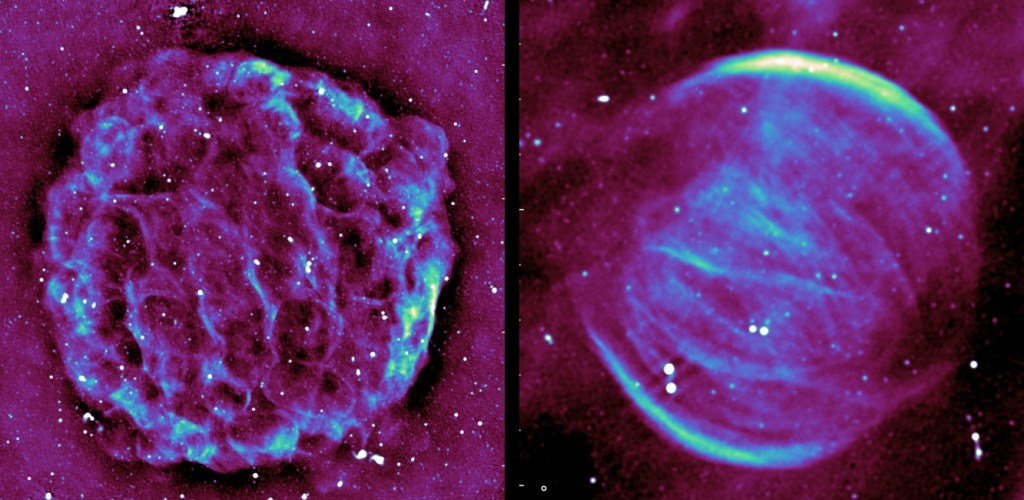
In a new study, astronomers have utilized the MeerKAT L-band array to delve deeper into 36 supernova remnants (SNRs) across a specific frequency range of 856–1712 MHz. The observations have unveiled detailed, high-dynamic-range images brimming with intricate structures, marking a significant advancement in our understanding of these celestial phenomena.
The MeerKAT observatory, a radio telescope located in South Africa, is part of the larger Square Kilometre Array (SKA) project. It operates in the radio frequency spectrum and is one of the most sensitive and powerful radio telescopes in the world. The goal of the observatory is to delve into astronomical mysteries by observing the universe in the radio spectrum.
It’s capable of capturing information that can’t be seen with optical telescopes, providing unique insights into areas such as the formation and evolution of stars, galaxies, and cosmic structures. MeerKAT contributes significantly to our understanding of the universe, from studying neutral hydrogen gas in distant galaxies to uncovering new and complex structures in our own Milky Way.
In a show of the power and performance of the radio observatory, an object known as G15.1−1.6, previously classified as an SNR, has been reidentified as an H ii region, highlighting the precision of the MeerKAT’s imaging capabilities. Furthermore, G30.7−2.0, once thought to be a singular structure, has been revealed as a trio of extragalactic sources, forming an arc only when observed at lower resolutions.
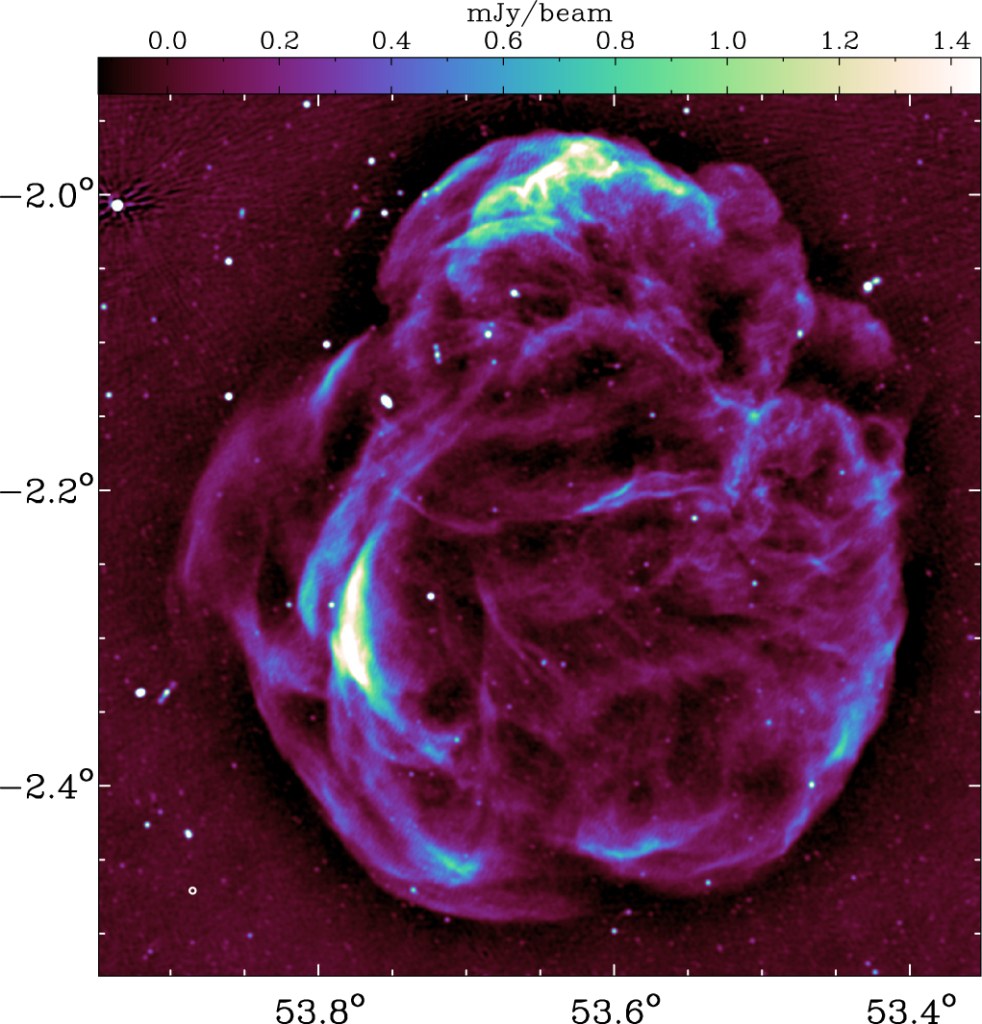
An intriguing discovery in the study is the prevalence of “blowouts” or “ears” in at least half of the observed supernova remnants, suggesting these features are a common characteristic of SNRs. Polarimetric data analysis has unveiled intricate details about the magnetic field structures within these remnants, shedding light on the magnetized thermal plasma present and its interaction with polarized emissions.
A particularly fascinating case is that of G327.6+14.6, which is fortuitously aligned with a distant active galactic nucleus. This unique alignment has allowed astronomers to investigate Faraday effects within the remnant, although minimal evidence of Faraday rotating material was found.
The MeerKAT’s observations have not only enhanced our understanding of the physical structure and magnetic properties of SNRs but also reinforced their critical role in galaxy evolution. These remnants, products of either thermonuclear or core-collapse supernovae, significantly contribute to enriching the interstellar medium (ISM) with heavy elements and fostering the birth of new stars.
The study underscores the diverse nature of SNRs, influenced by factors such as age, explosion energy, and the surrounding ISM. It also highlights the relevance of GHz to sub-GHz radio observations in probing the spectral aging, dynamics, and particle acceleration processes within these remnants.
As a testament to the MeerKAT’s capabilities, this comprehensive analysis not only provides a deeper understanding of known SNRs but also paves the way for future discoveries in the realm of astrophysics.
Source: D, Cotton W, et al. “MeerKAT 1.3 GHz Observations of Supernova Remnants.” The Astrophysical Journal Supplement Series, vol. 270, no. 2, 2024, p. 21, dx.doi.org/10.3847/15384365/ad0ecb, https://doi.org/10.3847/15384365/ad0ecb.
Featured Image: SRNs with MeerKAT at 1335 MHz, Cotton et. al.


 ad*astra daily