
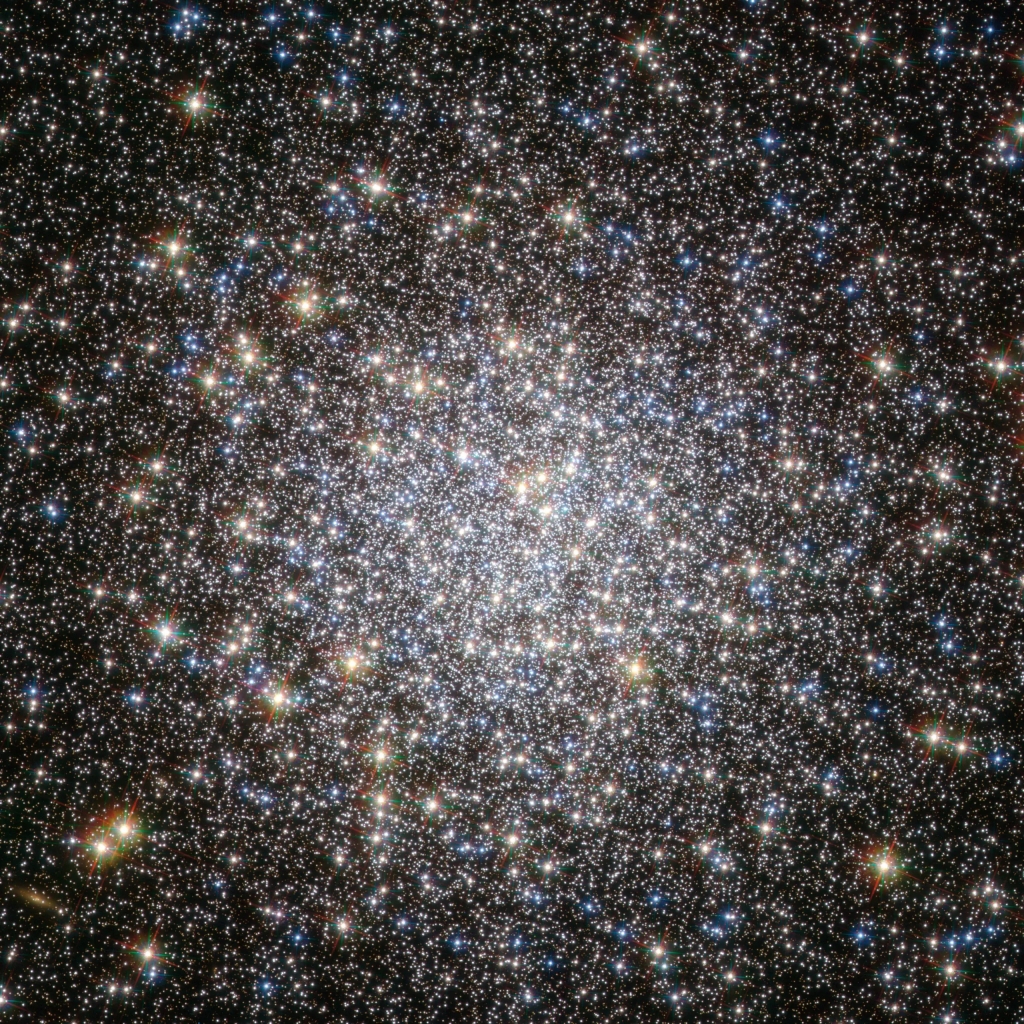
In a groundbreaking series of studies, astronomers have been captivated by ZNG 1, an unusual and bright ultraviolet star in the globular cluster M5. Initially identified in 1972 by Zinn et al., this star stands out for its unique properties, including an extraordinary rotational velocity and a peculiar chemical makeup.
The intrigue around ZNG 1 began with Bohlin et al.’s 1983 observations using a rocket-borne telescope, which located the star approximately 20” from the cluster’s center. Follow-up studies with the International Ultraviolet Explorer revealed the star’s exceptional traits, such as strong resonance lines of nitrogen and carbon, and an estimated surface temperature of about 35,000 K. Notably, the presence of a nitrogen-rich planetary nebula was hypothesized, based on the observed emissions.
Further analysis by de Boer in 1985, utilizing multiple spectra, refined the temperature estimates, although discrepancies in observations led to questions about the accuracy of certain emissions. The possibility of a surrounding planetary nebula prompted Napiwotzki & Heber in 1997 to conduct further investigations with the Hubble Space Telescope, which found no evidence of such a nebula. Their observations did, however, confirm the presence of strong wind features and various photospheric lines, similar to those found in comparable stars.
The Far Ultraviolet Spectroscopic Explorer (FUSE) brought new insights in 2004, with Dixon et al. presenting a detailed analysis of ZNG 1’s spectrum. They discovered an incredibly high surface temperature, significant rotational velocity, and a helium-rich atmosphere. Further studies in 2008 by Zech et al. utilizing both FUSE and Hubble Space Telescope data indicated that certain observed high-velocity absorptions were not circumstellar but rather due to interstellar phenomena.
The latest research, using a comprehensive set of data and advanced models, has led to revised estimates of the star’s parameters and elemental abundances. Moreover, the current hypothesis suggests that ZNG 1 may be a product of a stellar merger, possibly involving a pair of helium-core white dwarfs. This conclusion marks a significant advancement in understanding this enigmatic star, offering insights into the complex processes shaping our universe.
Source
Dixon, William V. “Observations of the Ultravioletbright Star ZNG 1 in the Globular Cluster M5 (NGC 5904).” The Astronomical Journal, vol. 167, no. 2, 2024, p. 47, dx.doi.org/10.3847/15383881/ad11e0, https://doi.org/10.3847/15383881/ad11e0.
Image
NASA STScI
 ad*astra daily