
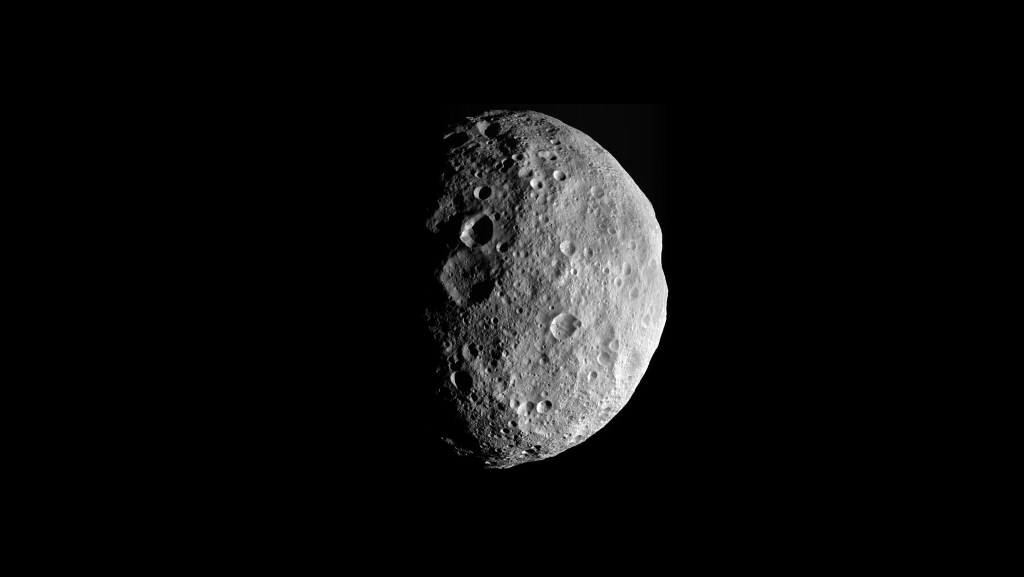
Vesta, one of the largest objects in the asteroid belt, presents a unique opportunity for understanding the early solar system and the processes that shaped terrestrial planets, including Earth.
Lost Planet
Vesta, officially designated as 4 Vesta, is one of the largest asteroids in the solar system. Discovered by Heinrich Wilhelm Olbers in 1807, it is unique among asteroids for its differentiated structure, resembling the layered composition of terrestrial planets. This structure includes a crust, a mantle, and a core, suggesting that Vesta underwent a process similar to planetary differentiation, a significant trait that sets it apart from most other asteroids.
Vesta is approximately 525 kilometers in diameter, making it the second-largest body in the asteroid belt after the dwarf planet Ceres. Its surface features a variety of interesting geological formations, including craters, troughs, and a massive impact basin at its south pole, known as Rheasilvia. This basin is notable for its central peak, which rises to impressive heights, rivaling some of the tallest mountains in the solar system.
Coming into Focus
Vesta resides in the asteroid belt, a region of space located between the orbits of Mars and Jupiter. This belt contains a vast number of rocky bodies, remnants from the early solar system that never coalesced into a planet due to the gravitational influence of Jupiter.
Observing Vesta is feasible with amateur telescopes when it is at opposition, the point in its orbit when it is closest to Earth. However, detailed study requires space missions. NASA’s Dawn spacecraft, launched in 2007, provided the most in-depth exploration of Vesta. During its mission, Dawn entered orbit around Vesta, delivering high-resolution images and data on its surface composition, topography, and geology. This data has been instrumental in enhancing our understanding of Vesta’s characteristics and its history.
Lost Planet
Vesta holds immense scientific importance due to its status as a protoplanet, a body that started forming into a planet but did not complete the process. Its differentiated structure offers a glimpse into the processes that occurred in the early solar system, particularly those related to planetary formation.
The study of Vesta helps scientists understand how planets, including Earth, underwent differentiation and evolved over time. Vesta’s geological history, preserved in its surface features and composition, provides clues about the conditions and materials present in the early solar system. By examining these characteristics, researchers can infer the processes that led to the formation of terrestrial planets.
Additionally, Vesta is believed to be the source of a significant number of meteorites that have fallen to Earth, known as HED meteorites (Howardite, Eucrite, and Diogenite). These meteorites provide a direct physical link to Vesta, allowing scientists to study its composition in laboratories on Earth. Through these analyses, researchers can validate observations made by space missions and enhance our understanding of Vesta’s geological history.
Vesta is not just an asteroid but a key to unlocking the mysteries of planetary formation and evolution. Its unique characteristics and the wealth of data obtained from missions like Dawn have made it a cornerstone in the study of the solar system’s history. By understanding Vesta, we gain valuable insights into the processes that shaped the terrestrial planets, including our own Earth, and the dynamic history of our solar system.
 ad*astra daily