
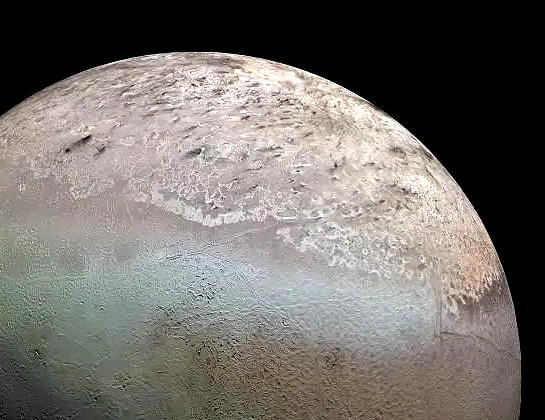
Neptune’s moon Triton stands as one of the most intriguing and enigmatic bodies in our solar system. Discovered in 1846 by British astronomer William Lassell, just 17 days after Neptune itself was identified, Triton is unique among the large moons of the solar system for its retrograde orbit – an orbit opposite to the planet’s rotation. This characteristic immediately hints at Triton’s exotic origin and complex history, making it an object of significant scientific interest.
Chilly Giant
Triton, the largest moon of Neptune, is notably different from other large moons in the solar system. It is primarily composed of a mix of water ice and rock, with a surface marked by nitrogen and methane ices. Triton is particularly notable for its extremely cold surface, with temperatures plunging to about -235 degrees Celsius, making it one of the coldest places in our solar system. Despite these frigid conditions, Voyager 2’s flyby in 1989 revealed active geysers spewing nitrogen gas – a startling discovery that indicated Triton’s interior might still be warm and geologically active.
Coming into View
Triton orbits Neptune, the eighth planet from the Sun, residing in the outer reaches of our solar system. This vast distance makes direct observation challenging. The primary source of detailed information about Triton comes from the Voyager 2 spacecraft, which conducted a flyby of Neptune and its moons in 1989. This mission provided invaluable data and images, offering a rare close-up view of this distant world. Since then, observations using telescopes like the Hubble Space Telescope and ground-based observatories have continued to shed light on Triton’s characteristics, although these views are understandably less detailed than those provided by Voyager 2.
Captured Wanderer
Triton plays a crucial role in our understanding of Neptune and the solar system for several reasons. First, its retrograde orbit suggests that Triton is likely a captured Kuiper Belt object, a remnant from the early days of the solar system’s formation. This capture would have had significant consequences for both Triton and Neptune, including altering Triton’s original orbit and potentially affecting Neptune’s own satellite system and rotational dynamics.
Triton also serves as a window into the processes that shape and affect icy bodies in the solar system, especially those in the Kuiper Belt. Its active geological features, like the nitrogen geysers and potential subsurface ocean, provide insights into how similar bodies might evolve over time and how they interact with their environment. Understanding Triton’s geology and composition helps refine our models of planetary system formation and evolution.
Triton’s atmosphere, albeit thin, is composed mainly of nitrogen with traces of methane, similar to Titan, Saturn’s largest moon. Studying Triton’s atmospheric processes and composition can offer parallels or contrasts to Titan, aiding our broader understanding of planetary atmospheres in the solar system.
Neptune’s moon Triton is not just a distant icy world orbiting the eighth planet. It is a key to unlocking mysteries of planetary formation, moon evolution, and the dynamic processes at play in the outer solar system. Its unique characteristics and the data gleaned from observations continue to contribute to our understanding of the cosmos, making Triton a vital subject in planetary science and astronomy.
 ad*astra daily