
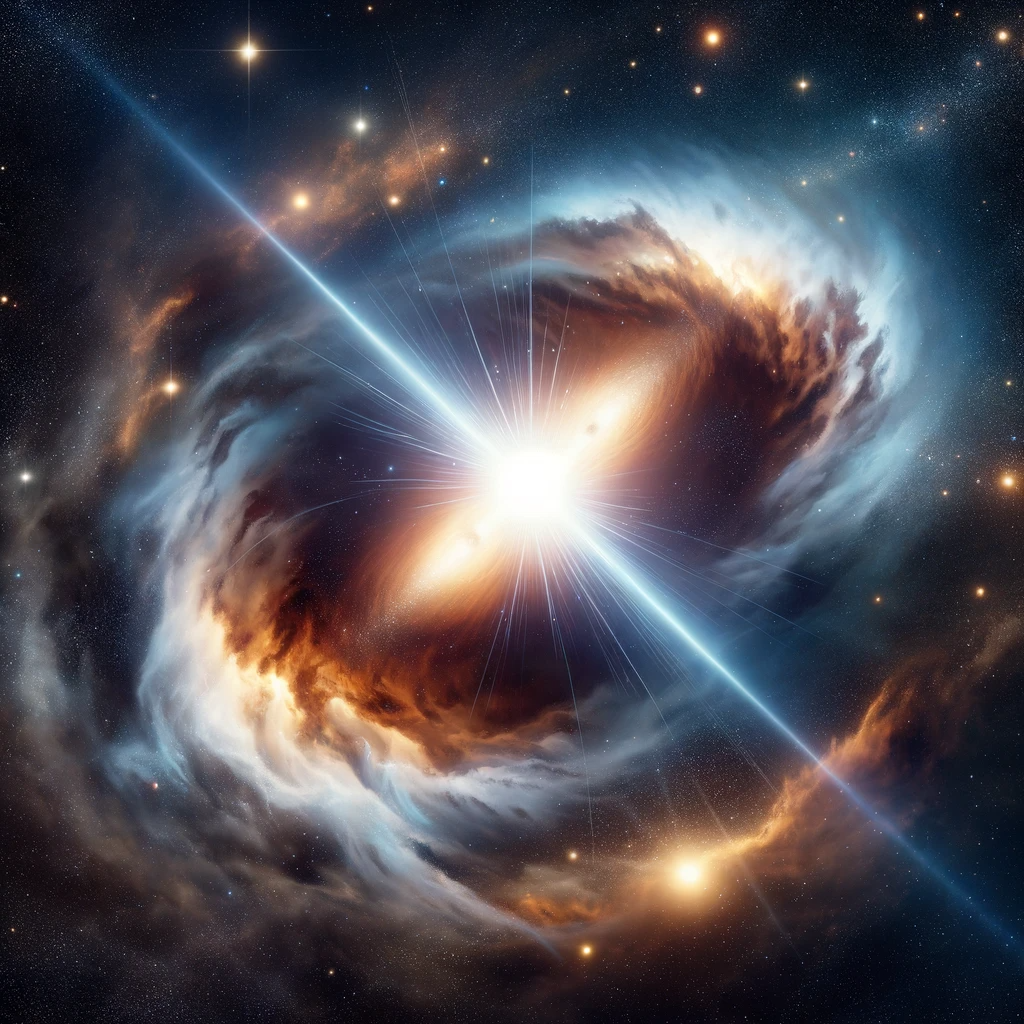
Quasars, or quasi-stellar objects, are some of the most luminous and enigmatic objects in the universe, offering a window into the early epochs of cosmic evolution and the mechanics of supermassive black holes. These celestial phenomena challenge our understanding of physics under extreme conditions and play a critical role in the study of galaxy formation and evolution.
Energetic Powerhouse
Quasars are the intensely bright centers of distant galaxies, powered by supermassive black holes. A black hole, a region in space with gravitational pull so strong that not even light can escape, becomes a quasar when it is actively accreting material. This material, usually gas and dust, spirals in towards the black hole, forming an accretion disk. As the matter in this disk accelerates and heats up, it emits tremendous amounts of energy, often outshining the entire galaxy that hosts the quasar. This brilliance makes quasars visible across vast cosmic distances, despite their compact size.
Quasars emit energy across a broad spectrum, from radio waves to visible light to high-energy gamma rays. This emission is often non-uniform, characterized by rapid variability in brightness. The immense energy released can be a hundred times greater than that produced by all the stars in a typical galaxy, making quasars some of the brightest objects in the observable universe.
Lighthouse in the Distance
Quasars are predominantly found in the distant universe, billions of light-years away. Their high luminosity allows them to be observed even at these extreme distances, making them valuable tools for studying the early universe. The light we see from quasars today has traveled for a significant fraction of the age of the universe, providing a glimpse into the past, often back to a time when galaxies were young and forming.
Astronomers observe quasars using a variety of telescopes and methods. Optical telescopes can detect the visible light they emit, while radio telescopes capture their radio-frequency emissions. Space-based observatories, like the Hubble Space Telescope, play a crucial role in observing these distant objects, free from the distortion of Earth’s atmosphere.
Beacon from the Past
Quasars are essential to our understanding of the universe for several reasons. Firstly, they act as lighthouses in the distant universe, helping astronomers probe the conditions of the early cosmos. Their light can be used to study the intergalactic medium and the evolution of galaxies over cosmic time.
The study of quasars provides insights into the nature and growth of supermassive black holes, which are believed to reside at the center of most large galaxies. Understanding how these black holes influence their host galaxies is a key topic in astrophysics. The interaction between quasars and their surrounding environment is thought to play a critical role in galaxy formation and evolution, a process known as feedback.
Additionally, quasars are a testbed for fundamental physics. The extreme conditions in the vicinity of the supermassive black hole – high gravitational fields, velocities close to the speed of light, and intense radiation – offer a unique environment to test theories of gravity and high-energy physics.
Quasars are not just spectacular astrophysical phenomena but also crucial tools for understanding the universe. Their study sheds light on the early universe, the nature of supermassive black holes, and the complex interplay between black holes and galaxy evolution, deepening our comprehension of the cosmos and its myriad mysteries.

 ad*astra daily