
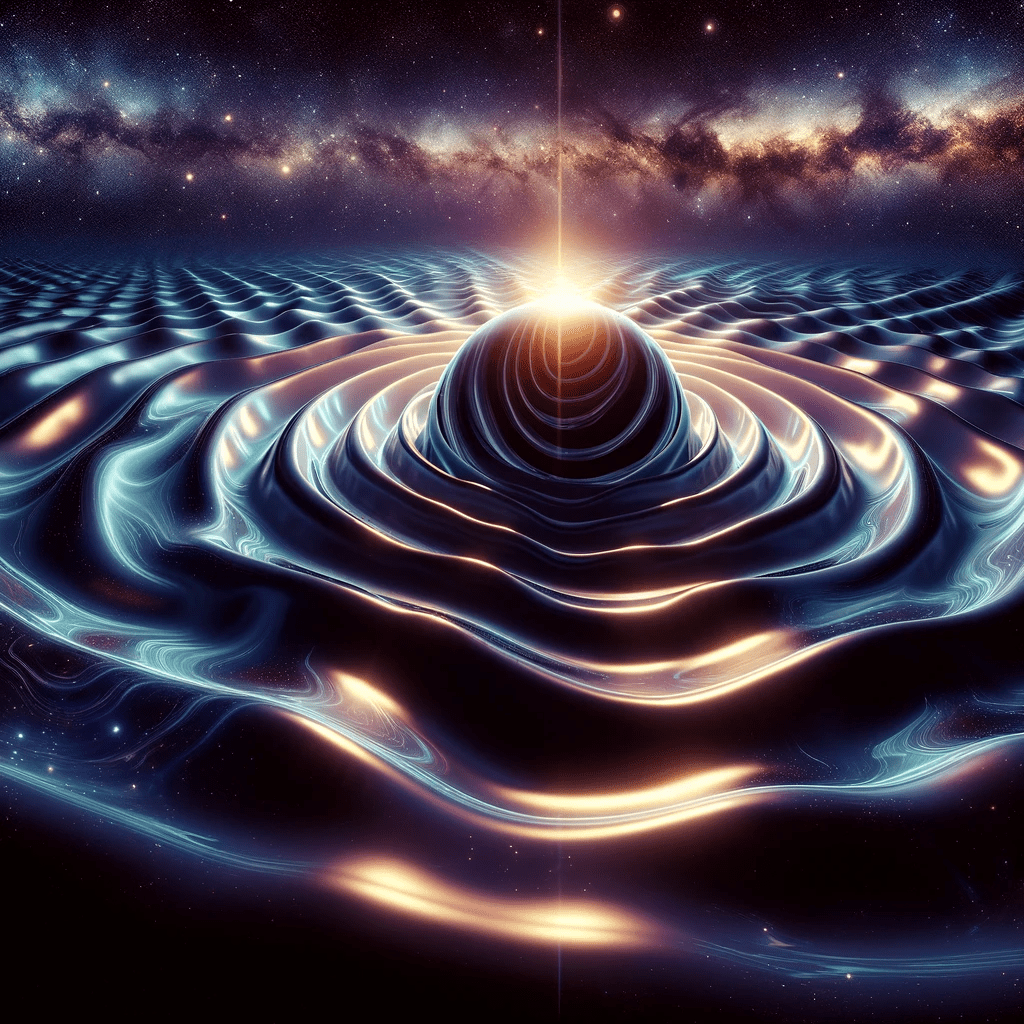
Gravitational waves, a profound concept in astrophysics, have become instrumental in our understanding of the universe. Their discovery and ongoing study offer a new lens through which we can observe and comprehend cosmic events and the very fabric of spacetime. This essay explores the nature of gravitational waves, their detection, and their significance in enhancing our understanding of the universe.
A Ripple in Spacetime
Gravitational waves are ripples in the fabric of spacetime, generated by some of the most violent and energetic processes in the universe. Predicted by Albert Einstein in 1916 as a consequence of his General Theory of Relativity, these waves are disturbances that propagate at the speed of light, carrying energy away from their source. The theory posited that massive objects, like stars or black holes, when accelerated, would produce waves in spacetime much like a stone creates ripples in a pond.
The production of gravitational waves requires events involving significant mass and acceleration, such as the collision of black holes, the explosion of supernovae, or the merging of neutron stars. These cataclysmic events cause distortions in spacetime that radiate outward, much like waves in water.
Breakthrough Technology
Gravitational waves permeate the universe, but detecting them is extraordinarily challenging due to their incredibly weak nature. The waves cause minute changes in spacetime as they pass through an area, contracting and expanding distances but by an infinitesimally small amount. For decades, this made their direct detection elusive.
The breakthrough came with the development of highly sensitive detectors, specifically Laser Interferometer Gravitational-Wave Observatory (LIGO) and its European counterpart, Virgo. These observatories use laser interferometry to measure the tiny changes in distance caused by passing gravitational waves. In this setup, lasers travel along long tunnels, and the minute distortions in spacetime due to a gravitational wave alter the travel time of the light, creating an interference pattern that can be detected and analyzed.
The first direct observation of gravitational waves was made by LIGO in September 2015 and announced in February 2016. This historic detection, originating from the merger of two black holes about 1.3 billion light-years away, opened a new window for astronomical observation.
Measuring the Unseen
The importance of gravitational waves lies in their ability to provide information about events and objects in the universe that are otherwise invisible or difficult to observe. Unlike electromagnetic waves (light), which can be absorbed or scattered by interstellar dust and gas, gravitational waves pass through matter almost unimpeded, offering a clear picture of the phenomena that created them.
Gravitational wave astronomy allows us to study the properties of black holes and neutron stars, shedding light on their formation, evolution, and the extreme conditions of gravity and matter within them. This is crucial for testing the predictions of General Relativity, particularly in the strong-gravity regime.
Furthermore, gravitational waves carry information about their origins that is unobtainable by any other astronomical means. For instance, the detection of gravitational waves from the merger of neutron stars has been linked with the observation of gamma-ray bursts, providing evidence for the long-held theory that such mergers are the cause of these bursts.
Research into gravitational waves could eventually offer insights into the earliest moments of the universe, potentially observable through background gravitational waves produced by the Big Bang, much like the Cosmic Microwave Background in electromagnetic observation.
Gravitational waves are not merely a theoretical curiosity but a groundbreaking discovery that has revolutionized our understanding of the universe. They provide a new method to observe and study cosmic phenomena, complementing traditional astronomical tools, and deepening our knowledge of the cosmos’s most enigmatic and powerful events. As gravitational wave detection becomes more advanced, it promises to unlock further secrets of the universe, contributing significantly to the field of astrophysics and our overall cosmic understanding.
 ad*astra daily